
Delimitation in India: Political Equality and federalism
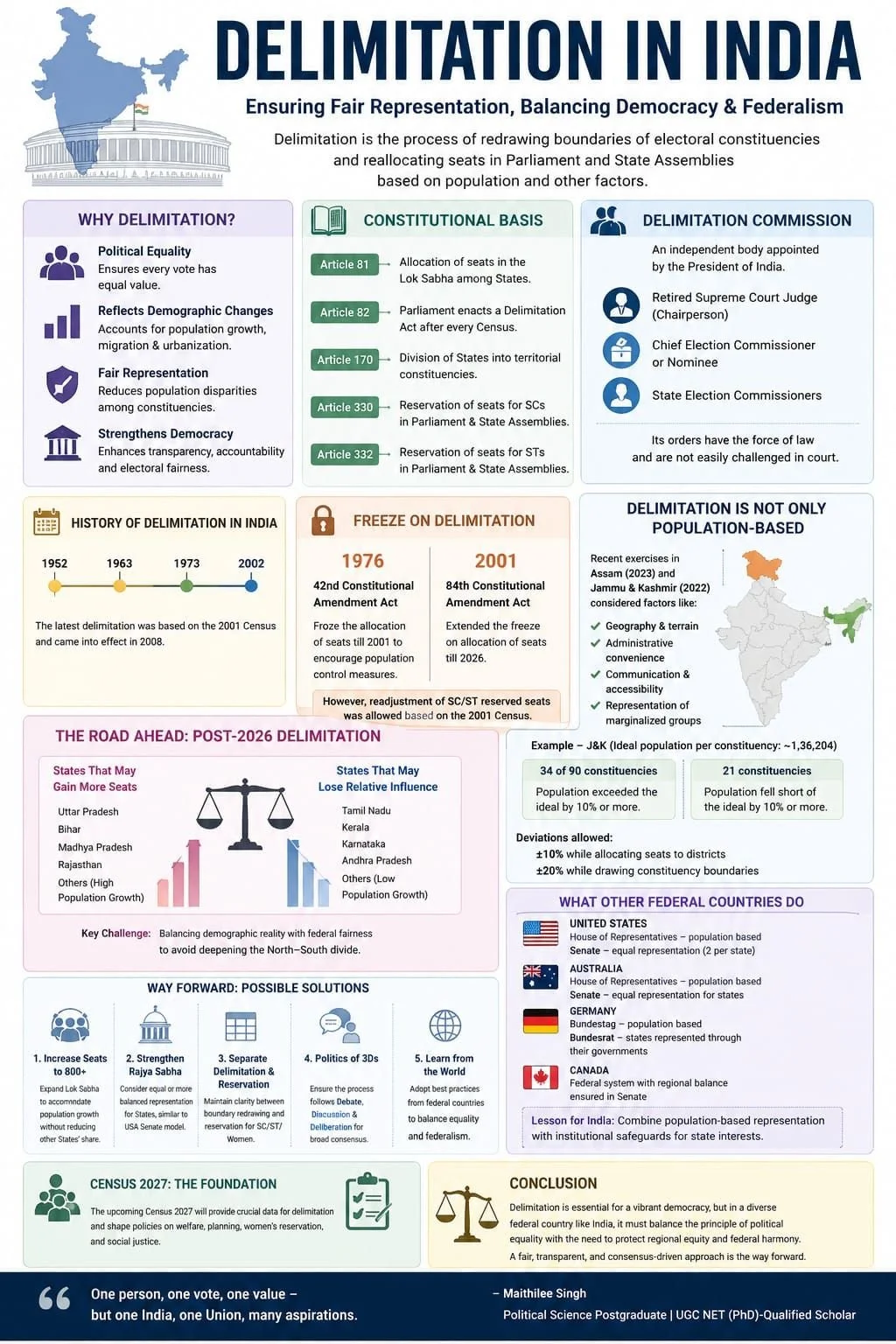
In India, delimitation is the constitutional procedure of the redrawing of electoral boundaries of the electoral districts of the Lok Sabha and the State Legislative Assemblies to assure equitable political representation in view of population shifts. Not only does it influence the number of seats, but also the allotment of seats to Scheduled Castes (SCs) and Scheduled Tribes (STs), thus making it a very crucial tool to enforce the principle of one person, one vote in the Indian federal system.
Meaning and Constitutional Framework.
Delimitation is the process of correcting the number of seats in the Lok Sabha and the State Assemblies, redrawing of the territorial constituencies, and the establishment of seats in the Lok Sabha that are reserved to SCs and STs. This process has a legal basis in the Constitution of India under:
Article 81: Distribution of the seats of Lok Sabha among the states in terms of population.
Article 82: Each Census is followed by a Delimitation Act passed by Parliament to redistribute these seats.
Article 170: Separating of the states into territorial constituents.
Article 330 and 332: SCs and STs reservation of seats in Parliament and State Assemblies.
These are in place to make sure that as population changes in the case of urbanization, migration and demographic changes, the electoral map is revised as well to match the changes.
The Delimitation Commission
The President appoints the Delimitation Commission of India which is a high-powered and independent body entrusted with the task of carrying out the delimitation exercise. It is usually composed of:
A retired Supreme Court judge as Chairperson.
The Chief Election Commissioner (CEC).
State Election Commissioners of the respective states.
They are not easily amenable to legal scrutiny in the court and the decisions given by the Commission are legally binding and thus the process is not prone to political interference.
The Freeze and Evolution In History.
In 1952, 1963, 1973, and 2002, Commissions of Delimitation were created, the most recent large-scale Commission being carried out in 2008 on the basis of the 2001 Census. To stimulate population control, however, the 42nd Constitutional Amendment Act (1976) put a freeze on seat allocations to 2001, and the 84th Amendment (2001) further froze it to the completion of the 2026 Census.
This freeze has been needed since the present distribution of seats is pegged on the 1971 Census which had a population of 548 million in comparison to the current population of 1.47 billion. This suspension will be suspended by the next Census 2027, which will initiate a complete delimitation exercise, probably after 2027.
Federalism vs Political Equality.
The principle of political equality requires that all votes should be approximately equal. Given that there are 100 voters in one constituency and 1,000 voters in the other, the 100 voters in the small constituency are disproportionately represented. Delimitation aims to reduce these differences, through keeping the population of each constituency as close as possible to the statutory norm.
Nonetheless, the federal system in India needs to balance between the population-based representation and the concerns of every state. States which have been effective in population growth control like Tamil Nadu and Kerala are afraid of losing relative power and more populated states like Uttar Pradesh and Bihar can get more seats. This contradiction underscores the issue of the ideal of democratic equality in representation and the federal need of ensuring regional equity.
Beyond Population: Case Studies.
The recent delimitation processes in Assam and Jammu and Kashmir have proven that population is not the only criteria.
Jammu and Kashmir (2022): The Delimitation Commission, which was established following the repeal of Article 370, raised the total number of seats in the Assembly to 94. The optimal number of people per constituency was about 136,204, and many of the constituencies were above or below this standard exceeding by more than 10%. Deviations were permitted by the Commission up to a percentage of 10 in the districts and 20 in the constituencies, giving precedence to geographical considerations, including the topography, accessibility, and administrative convenience.
Assam (2023): The unbalanced population growth among the districts was found in the Election Commission delimitation order of the Assembly constituencies in Assam, with densities of 38 persons per square kilometer in Dima Hasao and 1,096 persons per square kilometer in Kamrup (Metropolitan). The exercise recognized the necessity to reconcile population and administrative practicability and the regional representation.
These examples show that practice in delimitation is multidimensional, taking into consideration geography, infrastructure, and social inclusion.
The 2026–2027 Delimitation Debate
The delimitation that will occur after 2026 will be historic since this will be the first time any state has its Lok Sabha seats redistributed between states since 1976. It can dramatically change the political balance whereby the northern states will have more power and the southern states stand a chance of declining.
In this exercise, the data will be supplied by the Census 2027 which will be conducted in April 2026 onwards. The Census will have more precise data with digital enumeration and real-time monitoring, which will impact not only the delimitation but also the welfare policies, urban planning, and social justice initiatives.
Reservation of Women
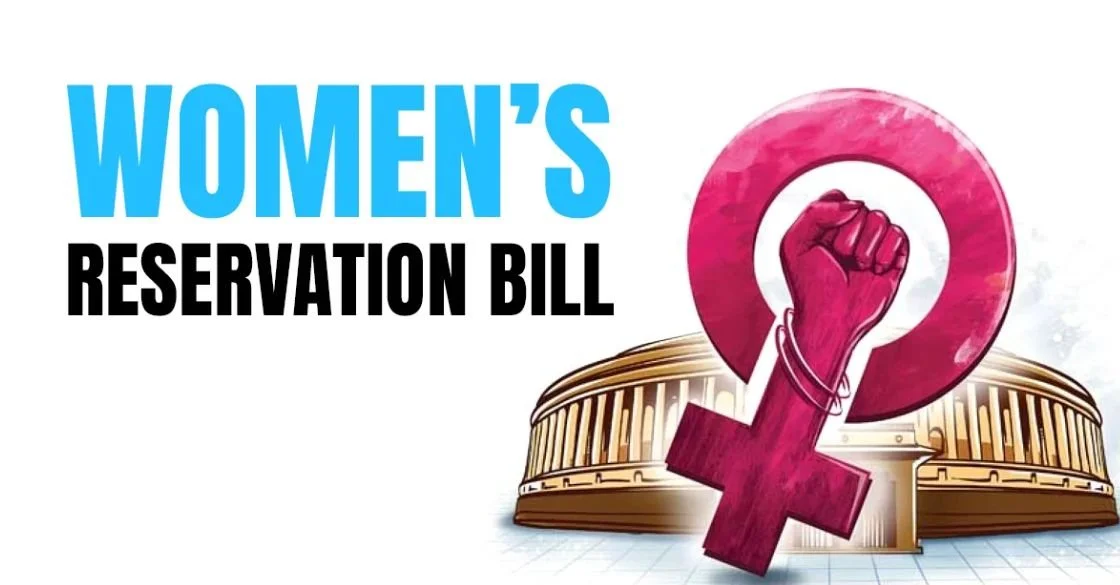
The next Census and delimitation is connected with the Women Reservation Act 2023 that reserves one-third of the seats in Lok Sabha and State Assemblies to women. The Delimitation Commission will also have the responsibility of forming women-only constituencies thus making it even more politically prominent.
Path to going forward: Striking a balance between Equity and Stability.
In order to maneuver through the intricacies of the imminent delimitation, the policymakers should take into account:
1. Increasing Lok Sabha Seats: One practical solution to the challenges posed by delimitation is to increase the strength of the Lok Sabha from the present 543 electric seats to 800 or more India's population has grown significantly since the last major seed allocation while the number of representatives has remained almost unchanged. This would help balance deployed equality with federal fairness.
2. Mixed Criteria: Fair representation may be guaranteed by adopting a formula that considers population, development measurements, and federal considerations. It is important to distinguish between the limitation and reservation so both are often discussed together. Delimitation refers to the redrawing of constituency boundaries and the reallocation of seats based on factors such as population, geography and administrative convenience. Reservation, on the other hand, refers to earmarking seats for historically underrepresented groups such as Scheduled Castes, Scheduled Tribes and women, based on constitutional and social justice considerations.
3. Empowering Rajya Sabha: Building strength in the Rajya Sabha can cushion state interest in the upper house, which will balance any disparities in the Lok Sabha. In the United States of America every state receives equal representation in the Senate regardless of population ensuring that smaller states are not politically marginalized. In India, Rajya Sabha representation is largely population based which gives larger states greater influence. A more balanced model of representation in the Rajya Sabha could safeguard the interests of smaller and Southern states. Examples such as Australia and Germany should also be taken into account.
4.Political Consensus: It is possible to have broad-based consensus prior to implementation which can reduce conflicts and the transition is smooth. Given its far reaching consequences for democracy representation and federalism the limitation should not be treated as a purely technical exercise. It must emerge through the 3DS of politics - debate, discussion and deliberation. Political parties, state governments, constitutional exports and civil society must engage in open dialogue to ensure that the process is transparent, inclusive and widely acceptable.
Conclusion
Delimitation in India is not simply a technical experiment but a political process which creates democracy, federalism and representation. The next delimitation of 2027 will shape the political dynamics in India, to challenge the equilibrium between equal representation and regional justice. With the Census 2027 and the Women Reservation Act approaching this exercise, India has a historic chance to shore up its democratic underpinnings and protect its federal makeup.
References
Election Commission of India. (2023). Final delimitation order for Assam Assembly constituencies.https://www.pib.gov.in/PressReleaseIframePage.aspx?PRID=1947865
India.gov.in. (n.d.). Delimitation Commission of India Order No. 51.http://india.gov.in/innerwin20.php?id=3830&title=+Delimitation+Commission+of+India+Order+No.51%24docu_type%3D1&cat1=
The Indian Express. (2024). Census next year, delimitation soon after, as Govt plans for next LS polls with new seats.https://indianexpress.com/article/political-pulse/census-next-year-delimitation-govt-caste-lok-sabha-polls-9642727/
iPleaders. (n.d.). Delimitation provisions in the Indian Constitution and important judgments.https://blog.ipleaders.in/delimination-provisions-indian-constitution-important-judgments/
Kashmir Times. (n.d.). In focus: News analysis—Re-shaped electoral boundaries, legal changes will impact voting outcome.https://kashmirtimes.com/in-focus/news-analysis-re-shaped-electoral-boundaries-legal-changes-will-impact-voting-outcome
Secretariat. (n.d.). Census 2027 schedule reopens debate over delimitation.https://thesecretariat.in/article/census-2027-schedule-reopens-debate-over-delimitation
Shankar IAS Academy. (n.d.). Delimitation process.https://www.shankariasparliament.com/current-affairs/delimitation-process
State Election Commission Kerala. (n.d.). Delimitation of wards in Panchayats and Municipalities.https://sec.kerala.gov.in/portal/kc/delimit
UCC India. (n.d.). Delimitation after 2027: Redrawing power in India.https://uccindia.org/delimitation-after-2027-redrawing-power-in-india/
