
“Thirty Years, Six Bills, and a Hollow Promise”
India’s attempt to reserve one-third of its legislative seats for women spans three decades and six bills, yet it remains a right that keeps getting delayed, or rather, denied.
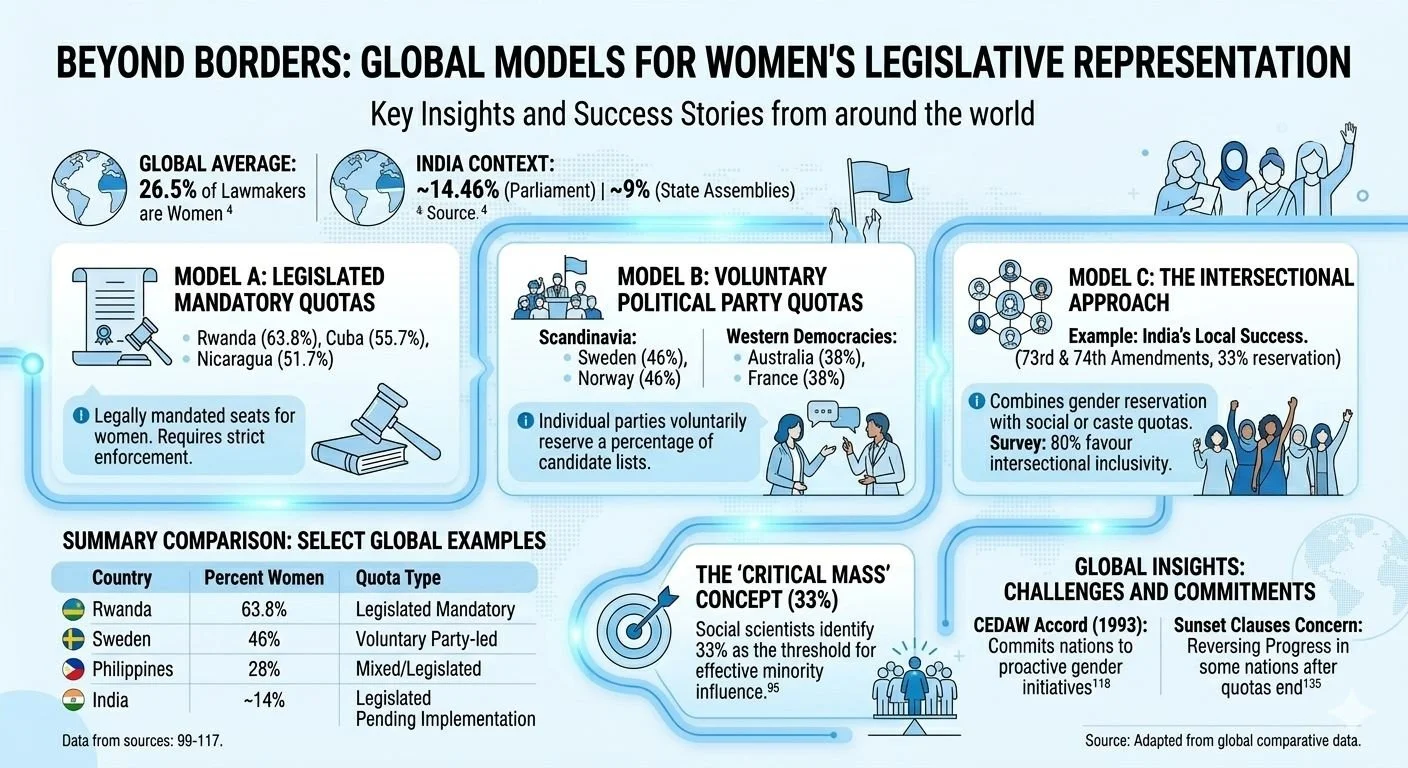
India has repeatedly been called the “mother” of all democracies. Yet, as of April 2026, female legislators ironically constitute only about 14.46% of the combined strength of the Parliament and 9% of the total members across various State Legislative Assemblies- a far cry from the global average of 26.5%. While this gap was meant to be addressed by the Nari Shakti Vandana Adhiniyam, 2023, the legislation remains toothless. And the recent defeat of the Constitution (131st Amendment) Bill, 2026 has only added another layer to this precarity.
The History of Women’s Reservation in India
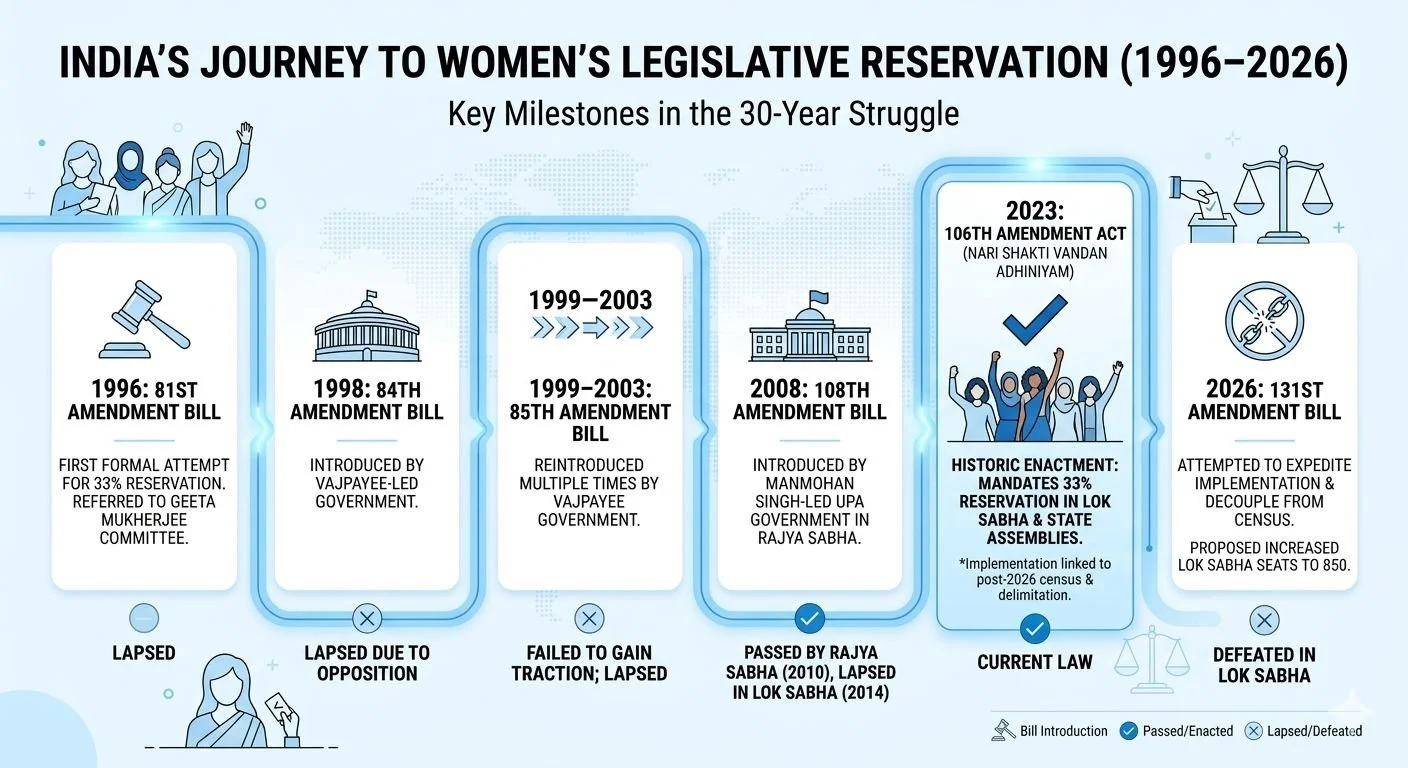
The first formal attempt to replicate the 33% reservation successfully used in local bodies via the 73rd and 74th Amendments to the national level was made by the Deve Gowda government in September 1996, in the form of the 81st Constitutional Amendment Bill, 1996. It was referred to the Joint Parliamentary Committee, chaired by Geeta Mukherjee. The Committee submitted its report in December 1996, but the bill lapsed upon the dissolution of the 11th Lok Sabha in 1998.
The 84th Amendment Bill, 1998, introduced under PM Vajpayee, faced severe opposition, and eventually lapsed when the 12th Lok Sabha dissolved in 1999.
The 85th Amendment Bill, 1999, again introduced under PM Vajpayee, was tabled multiple times in 1999, 2002 and 2003, but it failed to gain traction amid a lack of consensus, and ultimately lapsed when the 13th Lok Sabha dissolved in 2004.
The bill was revived under PM Manmohan Singh, when the 108th Amendment Bill was introduced in 2008. The Rajya Sabha passed it in 2010, but the Bill was never taken up for consideration by the Lok Sabha, and eventually lapsed upon its dissolution in 2014. A key feature in this bill was that reserved seats were to be rotated after every general election, a much more frequent cycle than what was proposed in the 2023 legislation.
Nari Shakti Vandan Adhiniyam, 2023
The Modi government reintroduced the women’s reservation bill, renamed as Nari Shakti Vandan Adhiniyam, in a special session of Parliament in September 2023. The Bill, which mandated reserving one-third (33%) of the total seats for women in the Lok Sabha, State Legislative Assemblies, and the Delhi Legislative Assembly, was passed in both Houses. It went on to receive Presidential assent on September 28, 2023, becoming the Constitution (106th Amendment) Act, 2023.
However, what differentiated this Act from its previous versions was an implementation clause. The Act stipulated that the reservation would only take effect once the next census is conducted and is followed by a delimitation exercise, and given that delimitation is a time-consuming procedure and the next census date remained unclear at the time, the proposed reservation may not come into effect at least until the 2029 general elections. Other concerns included the absence of a sub-quota for the Other Backward Classes (OBCs) and minority women, the exclusion of the Rajya Sabha from the ambit of the Act, and the 15-year “sunset clause” that was feared to limit women's empowerment in the long term.
Women’s Reservation Bill, 2026, in The Backdrop of Delimitation
The latest controversy erupted when the Constitution (131st Amendment) Bill, 2026, introduced by the present-day Modi government, sought to expedite the implementation of women's reservation by decoupling it from the next census, while also proposing a significant increase in Lok Sabha seats from 543 to 850 by lifting the five-decade-long freeze on delimitation.
Even though the government's attempt to operationalise the reservation was seen as being genuine in intent, its arrival, tied to an electoral restructuring, was deeply threatening to half of the country's states, especially those in the south and the northeast. The bill that was supposed to finally activate women's representation became the very instrument that escalated federal tensions. Consequently, the opposing states had to choose between supporting women's reservation and protecting their own political survival, and they chose survival. The Bill was defeated in the Lok Sabha on April 17, 2026, after failing to secure a two-thirds majority.
The “Trojan Horse”
The Bill was heavily criticised by the INDIA Bloc. The government was criticized for proposing a 50% increase in Lok Sabha seats without providing a clear rationale for either the expansion or the specific number chosen.
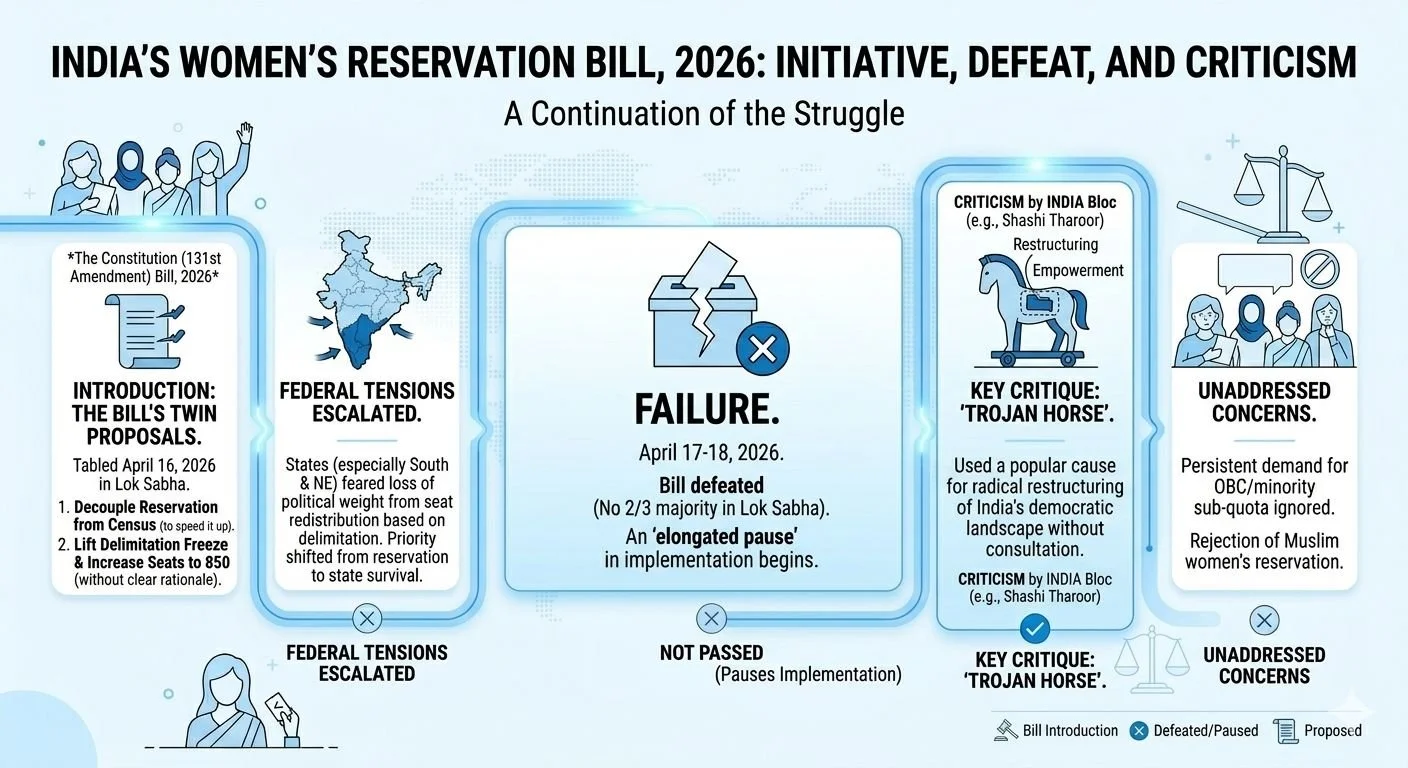
Shashi Tharoor described the Bill as a "Trojan horse," alleging the government used the popular cause of women's empowerment to push through a radical restructuring of India’s democratic landscape without consultation. Critics also pointed to the government's sudden shift from the 2023 position, which had originally mandated that a census be completed before implementation.
Additionally, persistent controversies from the 2023 Act remained a focal point during the 2026 debate. Parties representing OBCs and other minorities continued to demand a sub-quota, noting that the women from their respective communities make up a large portion of the population, yet they remain underrepresented. The government’s explicit rejection of reserved seats for Muslim women also remained a point of contention.
What the Defeat Means
Although the defeat of the Bill did not invalidate the 2023 Act, it symbolises an elongated pause in the implementation of women's reservation. It implies that implementation is once again contingent on two specific events- the publication of relevant figures from the first census conducted after 2026 and the subsequent delimitation exercise based on those figures, and because delimitation is a multi-year procedure and the next census is still being processed, experts believe the reservation is unlikely to come into effect before the 2029 general elections at least.
The failure to pass the Bill also defers immediate resolution on the question of a sub-quota for OBCs and minority women, which remains a primary point of contention for many political parties.
Global Scenario
Interestingly, India is not the lone example of a country that has had its fair share of struggles with integrating women’s reservation quota in its legislative system. Democracies worldwide have grappled with women's legislative representation by choosing between different quota systems, debating the philosophy of equality, and managing the speed of progress. While India took the route of a legislated quota, other nations have put forth varied models:
The Diverse Quota Model involves democracies typically choosing between legislated parliamentary quotas or voluntary quotas within political parties.
Countries like Rwanda, Bangladesh, Pakistan, Nepal, and South Korea have laws mandating reserved seats. In Nepal and South Korea, these reservations reach as high as 50%.
Many Western democracies, including Sweden, Norway, France, Germany, and the UK, do not have a national law reserving seats but rely on political parties to voluntarily reserve candidate slots for women.
Another idea, called “Philosophy of Equality”, supports the shift from "competitive equality" to "equality of result". The traditional liberal view here is that removing formal legal barriers, like granting the universal adult franchise, is sufficient for women to compete on merit.
The Critical Mass Theory (i.e., reaching a 33% threshold to influence decisions) is another popular idea adopted by the democracies that often struggle with achieving gender parity without intervention. Seemingly unwilling to wait for decades for gradual progress, India has adopted this theory to achieve parity in its legislative systems.
Notably, despite being established democracies, many large nations lag behind smaller or newer systems in terms of representation. As of 2026, Rwanda leads the world with 63.8% women in its national parliament, followed by Cuba (55.7%) and Nicaragua (51.7%). In Asia, the Philippines was among the first to introduce reservations and has surpassed the global average with 28% representation. Global models like Rwanda are noted for strict enforcement, which some argue is necessary to move beyond tokenism, while others fear it may not fit every democratic or federal context.
Democracies also struggle with the duration of quotas. There is significant global concern that "sunset clauses" can lead to a backslide in representation once the mandate expires, as seen in some nations (such as Algeria, Tunisia, El Salvador and Kazakhstan) where progress was reversed after quotas ended.
The Way Ahead
Following the defeat of the 2026 Bill, the way ahead for women's reservation in India requires navigating a landscape of political distrust while addressing deep-seated structural and federal concerns. Experts suggest the government should bring a standalone amendment that is decoupled from contentious issues, such as the delimitation freeze. This would allow for immediate implementation (as early as 2029) without raising federal tensions.
The way ahead must also involve engaging in patient and inclusive negotiation with the Opposition, and restoring faith in the institutional integrity of the delimitation process to ensure it is not perceived as a tool for partisan restructuring. The demands for a sub-quota for OBCs and minority women must also be addressed.
Women in politics can also be supported in other ways, such as mandatory women's wings and legal requirements for political parties to give women more leadership roles and election tickets, provide finance and mentorship programs for first-generation women politicians from marginalized backgrounds, and also strengthen laws to prevent the proxy phenomenon to ensure elected women exercise real agency.
The success of the reservation at the Panchayati level offers a roadmap. Future implementation can replicate capacity-building programs like Bihar’s JEEViKA or Kerala’s Kudumbashree to ensure that reserved seats translate into effective governance and social democracy.
The Bigger Picture
Evidence from local governance shows that female representatives tend to prioritize and invest more in public goods linked to women’s concerns, such as drinking water, sanitation, primary education, and public health. Increased female representation is also associated with the passage of more effective laws regarding sensitive issues, such as domestic abuse, sexual harassment, and rape. Greater diversity in the legislature will provide a wider range of viewpoints, leading to more inclusive policymaking and higher standards of governance. But the question India is yet to answer is, precisely when is the right time to include half of its citizens in its democracy?
References
Press Information Bureau. (17.04.2026). Union Home Minister replies in Lok Sabha to the discussion on the Delimitation Bill, 2026; the Constitution (131st Amendment) Bill, 2026; and the Union Territories Laws (Amendment) Bill, 2026. Ministry of Home Affairs. https://www.pib.gov.in/PressReleaseDetail.aspx?PRID=2253186®=3&lang=1
Ministry of Law and Justice. (2023). THE CONSTITUTION (ONE HUNDRED AND SIXTH AMENDMENT) ACT, 2023. Government of India. https://egazette.gov.in/WriteReadData/2023/249053.pdf
Patna High Court. (n.d.). GENDER EQUALITY AND WOMEN EMPOWERMENT: A CRITICAL ANALYSIS OF NARI SHAKTI VANDAN ADHINIYAM. https://patnahighcourt.gov.in/ILR/viewpdf.aspx?T=ARTICLE&ID=MQ%3D%3D-1HVw%2B63zNZA%3D
The Indian Express. (18.04.2026). In Parliament’s pushback on Women’s Reservation Bill, a lesson for government. https://indianexpress.com/article/opinion/editorials/in-parliaments-pushback-on-womens-reservation-bill-a-lesson-for-government-10642410/
The Indian Express. (27.04.2026). 131st Amendment Bill was about torching federal compact, not women’s reservation. https://indianexpress.com/article/opinion/columns/131st-amendment-bill-torching-federal-compact-not-womens-reservation-10658716/
The Indian Express. (01.05.2026). UPSC Issue at a Glance | Women in Parliament: Representation, reservation, and road ahead. https://indianexpress.com/article/upsc-current-affairs/upsc-essentials/upsc-issue-women-in-parliament-representation-reservation-bill-10662043/
Vidhi Centre for Legal Policy. (15.04.2026). Implications of the Constitutional Amendment and Legislative Package on Delimitation and Women’s Reservation. https://vidhilegalpolicy.in/research/implications-of-the-constitutional-amendment-and-legislative-package-on-delimitation-and-womens-reservation/
PRS Legislative Research. (n.d.). Women's Reservation Bill 2023 [The Constitution (128th Amendment) Bill, 2023]. https://prsindia.org/billtrack/the-constitution-one-hundred-twenty-eighth-amendment-bill-2023
PRS Legislative Research. (16.04.2026). Bill Summary: The Constitution (One Hundred and Thirty-First Amendment) Bill, 2026 [Delimitation Bills of 2026]. https://prsindia.org/files/bills_acts/bills_parliament/2026/Summary_Constitution_%28131st_A%29_Bill_2026.pdf
Supreme Court Observer. (25.09.2023). The Women’s Reservation Bill has a long history of arguments and stakes. https://www.scobserver.in/journal/the-womens-reservation-bill-has-a-long-history-of-arguments-and-stakes/
The Economic and Political Weekly. (25.04.2026). Historicising Women’s Reservation: Contextualizing the Women’s Reservation Bill in India. https://www.epw.in/engage/article/historicising-womens-reservation-contextualizing
Zaidi, S. & Khan, M. (2026). Charting A New Era: The Women Reservation Act and the Promise of Political Empowerment for Women in India. International Journal for Multidisciplinary Research, Volume 8, Issue 1. https://www.ijfmr.com/papers/2026/1/67279.pdf
