
The need for a defence dome - feasibility vs necessity?
Part 1
This is our first attempt on analyzing defence perspective on this website. We hope that we have tried to address the topics at hand in the best of capabilities
The mismatch - David vs Goliath
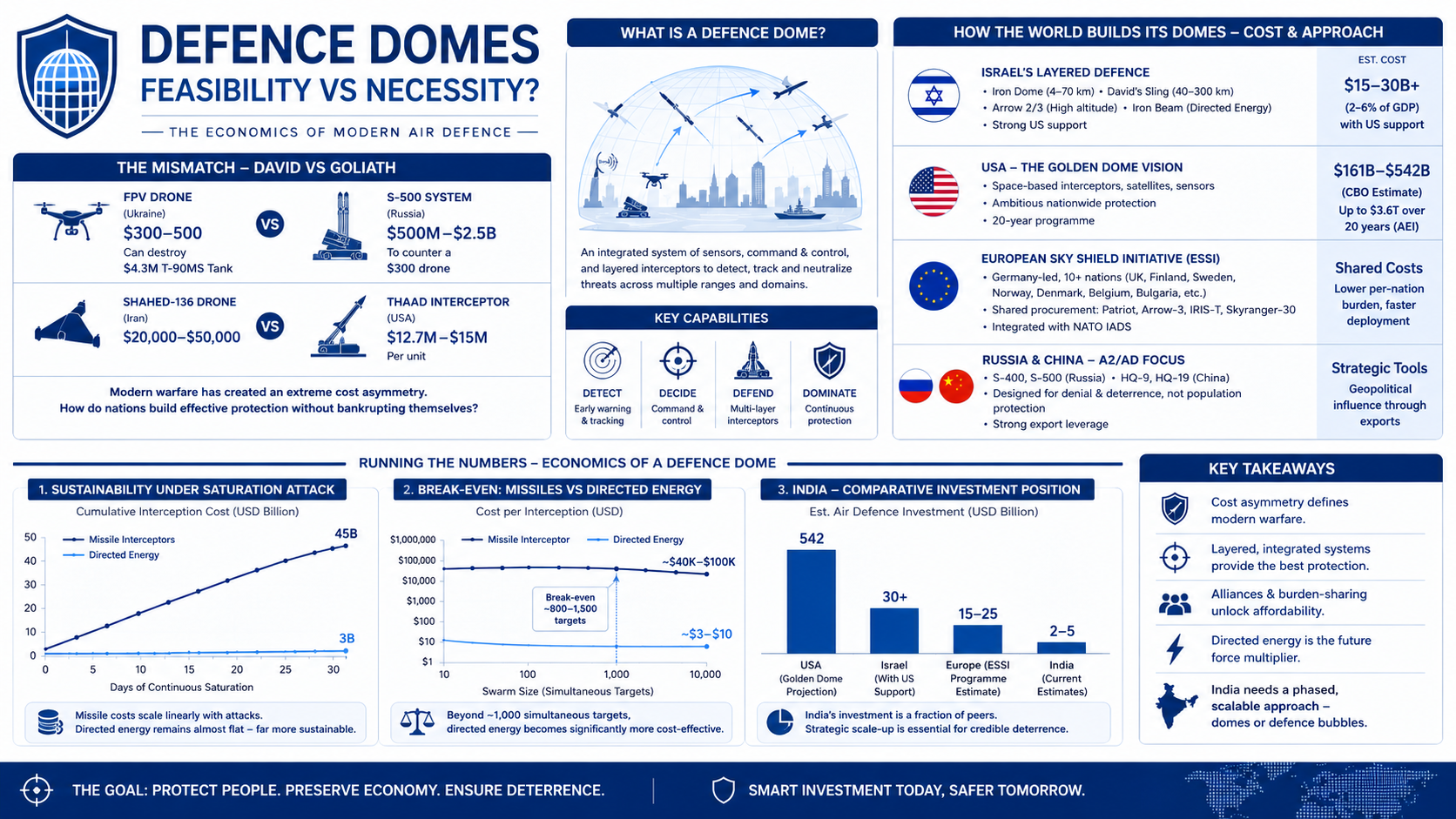
An FPV drone from the side of Ukraine costing a mere $300-500 can damage a T90 MS tank of Russia costing 4.3 Million dollars[1], and to counteract the same if the Russians were to deploy their S500, the cost might range to the order of $500 million to $2.5 billion depending on configuration, radars, launchers, and command systems. The modern defence simulations and security solutions hence have went beyond the conventional idea of a missile coming and missile going, yes the countries need credible defence, but at what cost and to what extent?
The ongoing West Asia crisis was a strategic show for how a drone power works, the Shaheed drones from Iran mounted a lot of pressure on the side of Israeli land, UAE airspace, and the ships of USA on sea. A Shahed-136 drone costs roughly $20,000–$50,000 to produce, while the THAAD (Terminal High Altitude Area Defense) interceptor missile used to destroy it costs approximately $12.7–$15 million per unit[2].
This research piece isn’t to analyze why these cheap drones are so powerful and effective yet so cheap or how the big defence systems protect the nations. This article here tries to see the economics behind creating a defence dome system and how much of a protection it can offer. And, should India attempt to have a “Golden Dome” like initiative?
What is a Defence Dome?
The ideas behind domes came into prominence post the videos of Iron Dome that circulated on social media. A spectacular show of defence capabilities on how Israel was able to protect Tel Aviv from the incoming missiles of Hamas showed the world of why we need a Dome based defence system. A Defence dome is in the easiest of terms can be understood to be as a integrated system of missile receptors and counter measure attacks that can to near perfection counter the attacks of an adversary.
(For the purpose of this research we are gonna analyze how a Defence Dome looks like and try to map its capabilities)
Also when we say the word dome, it can have multiple meanings and connotations here. For example the recent news of “Red, blue, white dome in Hormuz”[3] - “As a direct gift from the United States to the world, we have established a powerful red, white and blue dome over the strait. American destroyers are on station, supported by hundreds of fighter jets, helicopters, drones and surveillance aircraft providing 24/7 overwatch for peaceful commercial vessels, except Iran’s of course,” Defence Secretary Pete Hegseth[3]. So this shows what it means to be a defence dome - capability to counter adversary attacks with multiple arsenal at hand.
How nations have built their prominent Defence Dome? - the Economic costs
Israel’s Defence Dome
The Israeli Defence Dome can be divided into 4 Layers mainly -
Iron Dome with a Short-Range capacity to intercept rockets, drones, and mortars over a range of 4-70km. A single battery of Iron Dome has some 3-4 launchers and interceptor missiles(alongside radar capabilities) and which ends up costing 50-100 Million dollar(just remember Shaheed drone costed mere 20K dollars)
The Tamir interceptor missile here costs somewhat near $40,000−$100,000
David Sling with a capacity of Medium range 40-300km and targeting Cruise missiles and large rockets.
Arrow 2 and Arrow 3 for High altitude purposes and targeting Ballistic missiles upto 2400km
And a new operational concept the Iron Beam, use of directed energy to counter short range drones(this is at the cheaper end and costs 3.5 dollar per shot[4])
At a conservative estimate the entire operational cost here ranges somewhere near 2-6% of Israel’s GDP with significant support from USA. The United States contributed $1.6 billion directly to Iron Dome development and manufacturing alone from 2011-2022, with an additional $1 billion emergency approved in 2022[5]
Being surrounded by key adversaries near and beyond, Israel is one such country that has effectively used technology to make the best of use of their defence capabilities.
USA’s continental dream
USA has been one of the most innovative of all when it comes to coming up with ambitious projects around defence and security. Whether it be the “Rods from Space” idea or a “Star Wars Laser dome” idea, the ambitions have been truly ambitious. One such “Big Beautiful Project” is the Golden Dome project, estimated to cost 161-542 Billion dollars for building a space constellation led of interceptors(as per the Congressional Budget office[6]). The American Enterprise Institute's Todd Harrison, working from a robust architecture scenario, placed the 20-year programme cost at $3.6 trillion. Bloomberg's own modelling suggested a system capable of genuine peer-threat protection could reach $1.1 trillion.
The Greenland debate?
Yep it was very much part of this big idea!!
The Europe Model - Alliances!!
With a war still raging between Ukraine and Russia, the need for a European Line of Defence, is a safe bet for considerations
The European Sky Shield Initiative, proposed by Germany[7] in August 2022 in direct response to Russia's strikes on Ukrainian infrastructure, is made by multiple European states part of it(the UK, Finland, Sweden, Norway, Denmark, Belgium, Bulgaria). Its USP is polling of costs and avoiding the work being done in silos by independent national systems. ESSI enables joint procurement of platforms including Patriot, Arrow-3, IRIS-T, and Skyranger-30, with shared command integration into NATO's Integrated Air Defence System.
Why this becomes relevant, and why this can be a thing that India can try?
Working in close proximity to each other the ESSI's economic model is arguably the most replicable for medium-power states. What you get is a multilateral burden-sharing project and hence this helps to reduce per-nation cost, and hence creating interoperability, and accelerating deployment without requiring any single state to carry the full pressure of finances.
Suppose we in Asia now need such a thing to say maybe be create a deterrence to China in the South China Sea. With India already looking at defence deals with Indonesia and Philipiness, imagine such a system in the long run? Can be a good initiative for a deterrence, right?
The Russia and the China way of Defence
What Russia and China have isn’t a defence dome per se but rather denial and deterrence. In the technical and complex words, Russia's S-400 and S-500 systems, and China's HQ-9 and HQ-19 platforms, are anti-access/area-denial (A2/AD) architectures[8]. Basically these are systems designed to deny airspace to enemy states(not primarily to protect civilian populations).
Adding ahead here, for example - Russia's A-135 system around Moscow focuses on nuclear deterrence survivability, not city-wide protection. China's layered system is tied to Taiwan invasion and South China Sea access denial.
A key aspect of these two nations is their export capabilities, for example Russia’s S400 to India and Turkey and China’s HQ9 to Pakistan. Both these nations have basically transformed their air defence into geopolitical strength!!
So what should India as a nation try here?
A funding led investment and Joint Venture with USA/Germany/Russia?
A full India wide defence dome?
Defence bubbles across key strategic points??
Tune in soon for part 2 where we would try to see how India can leverage its position in this dynamics!!
Running the Numbers
The following simulations model three core economic questions that any serious dome policy must answer: How long can a nation sustain interception costs under saturation attack before fiscal stress? At what swarm size does directed energy become economically superior to missile interception? And what does India's comparative investment position look like against peer nations?
Simulation charts below have been created for the readers to know more around the economic contours of defence drone system!!
Fig. 1 — Interceptor Cost vs. Threat Cost by System
Log scale · Source: CSIS Missile Defense Project; Rafael Advanced Defense Systems
Note: Iron Beam ($3.50/shot) represents directed energy — the technology that inverts the cost equation entirely. The log scale is essential here: without it, Iron Beam's cost is invisible next to THAAD's $10M interceptor. Source: AJC Iron Beam brief, March 2026; Britannica — Iron Dome.
Fig. 2 — Saturation Attack Sustainability Simulation
Days until interception costs reach 5% of annual defence budget
Methodology: Threshold = 5% of annual defence budget. Average interceptor cost: $45,000 (blended inventory). Defence budgets used: USA $900B, India $84B (FY27 equivalent), Israel $24B, Russia $65B, China $225B, Europe/ESSI pool $280B. Sources: SIPRI 2025; PIB India FY26–27 BE; DoD FY27 request.
Fig. 3 — Directed Energy Crossover: When Do Lasers Beat Missiles?
Total interception cost ($M) — missile system vs. directed energy
Crossover occurs at approximately 15 simultaneous targets — the economic threshold that makes directed energy investment decisive for any nation facing drone swarm threats. Missile cost: $50,000 per interception (Iron Dome baseline). Laser cost: ~$3.50 per interception (Iron Beam, Rafael, 2025) plus $2M amortised infrastructure. Source: AJC Iron Beam brief 2026; Rafael Advanced Defense Systems.
Fig. 4 — Missile Defence Investment as % of GDP
Annual dedicated air and missile defence spending as share of national GDP · Source: SIPRI 2025
India at 0.04% GDP on dedicated missile defence against Israel's 1.2% illustrates both the investment gap and the fiscal headroom available. India's FY27 total defence budget (₹7.85 trillion / ~$92B) leaves meaningful space to scale targeted air defence investment without approaching the fiscal stress threshold. Source: SIPRI; Business Standard FY27 Defence Budget Analysis, February 2026; PIB India FY26–27 BE.
Fig. 5 — India: Strategic Bubble vs. Full National Dome — 10-Year Cost
Estimated 10-year programme cost, low and high estimates (USD billions)
India's "Strategic Bubble" model — protecting 6 priority nodes rather than attempting national coverage — costs approximately 74% less than a full dome approach while covering all genuinely irreplaceable assets: Delhi NCR, Trombay nuclear complex, INS Karwar, Mumbai port, Ladakh forward bases, Siliguri corridor. Source: Author modelling based on DRDO procurement costs, S-400 programme economics, and CSIS Missile Defense Project data.
So these graphs here show how the cost and interception looks like. This is a scaled reference created by Claude to show how much a defence dome would cost - the feasibility and economics behind it!!
References
Gdc. (2023, September 12). Ukraine’s $500 FPV drone destroyed Russia’s $4.3 million T-90MS main battle tank. Global Defense Corp. https://www.globaldefensecorp.com/2023/09/12/ukraines-500-fpv-drone-destroyed-russias-4-3-million-t-90ms-main-battle-tank/
Khan, B., & Khan, B. (2026, May 4). Shahed Drone: Iran’s attrition weapon and the Cost-Exchange crisis of 2026 - Quwa. Quwa - Pakistan Defence News Coverage & Analysis. https://quwa.org/iran/military-news-iran/shahed-drone-irans-attrition-weapon-and-the-cost-exchange-crisis-of-2026/
Online, E. (2026, May 5). The red, white and blue dome: Trump makes risky move to free Hormuz. The Economic Times. https://economictimes.indiatimes.com/news/defence/the-red-white-and-blue-dome-trump-makes-risky-move-to-free-hormuz/articleshow/130834450.cms?from=mdr
Online, E. (2026a, March 15). Why shoot a $3 million missile when a $3.50 laser can do the job: Inside the US military’s new drone defen. The Economic Times. https://economictimes.indiatimes.com/news/defence/why-shoot-a-3-million-missile-when-a-3-50-laser-can-do-the-job-inside-the-us-militarys-new-drone-defence-bet/articleshow/129584819.cms?from=mdr
Quinn, M. (2021, September 23). House approves bill providing $1 billion for Israel’s Iron Dome. CBS News. https://www.cbsnews.com/amp/news/iron-dome-1-billion-funding-house-bill/
Effects of Lower Launch Costs on Previous Estimates for Congressional Budget Office (.gov)https://www.cbo.gov › publication
Gotkowska, J. (2022b, October 17). Germany’s European Sky Shield Initiative. OSW Centre for Eastern Studies. https://www.osw.waw.pl/en/publikacje/analyses/2022-10-14/germanys-european-sky-shield-initiative
Jrosenstein. (2024b, September 10). Russian and Chinese strategic missile defense: Doctrine, capabilities, and development. Atlantic Council. https://www.atlanticcouncil.org/in-depth-research-reports/issue-brief/russian-and-chinese-strategic-missile-defense-doctrine-capabilities-and-development/
