
The West Asia Crisis and its Impact on India - Explained
The Context of the West Asia crisis
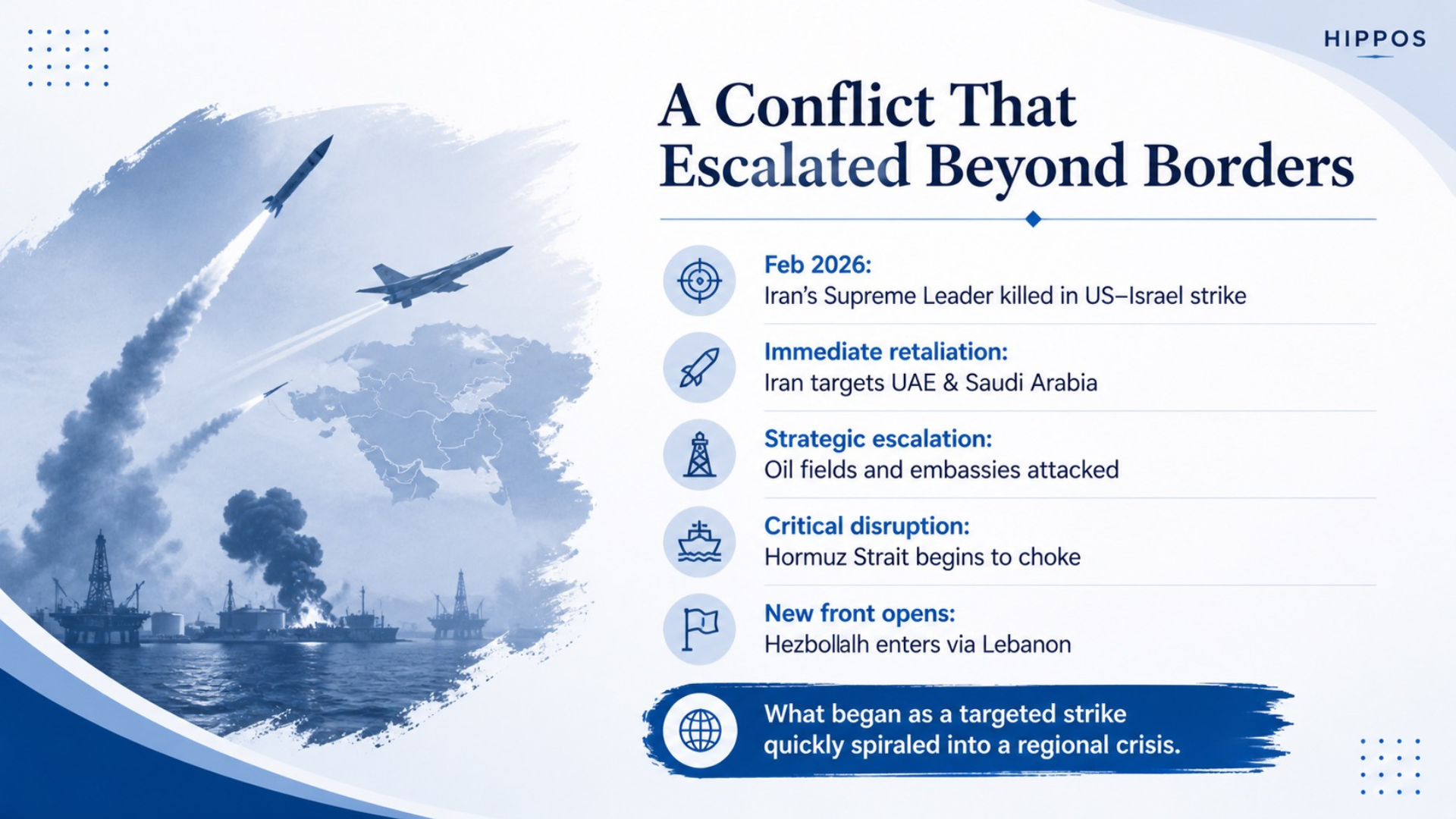
February 28th 2026 marked a turn in the event of history of West Asia as Ali Hosseini Khamenei, the Supreme Leader of Iran gets killed in a missile attack launched by USA and Israel. Social network analysis1 by Israel to track surveillance systems in Iran and a go ahead from CIA saw this event unfolding, and what pursued was rising escalation in West Asia as Iran started to bomb neighboring countries like UAE and Saudi Arabia, and also starts to choke the Hormuz Strait, while the top leadership of Iran is being killed by the tactical attacks of USA and Israel.
Situations tend to escalate further as Iran starts targeting embassies and oil fields around West Asia, leading to closure of Ras Laffan in Qatar(biggest natural gas plant for the region) and Ras Tanura in Saudi Arabia(biggest oil field in the region). Situation further escalated as sea mines were being deployed by Iran in the Strait of Hormuz and as a new front is opened by Hezbollah in Lebanon. With deployment of ships and carriers in Persian Gulf region from the side of USA rising, the revebrations of the crisis has impacted the entire world economy.
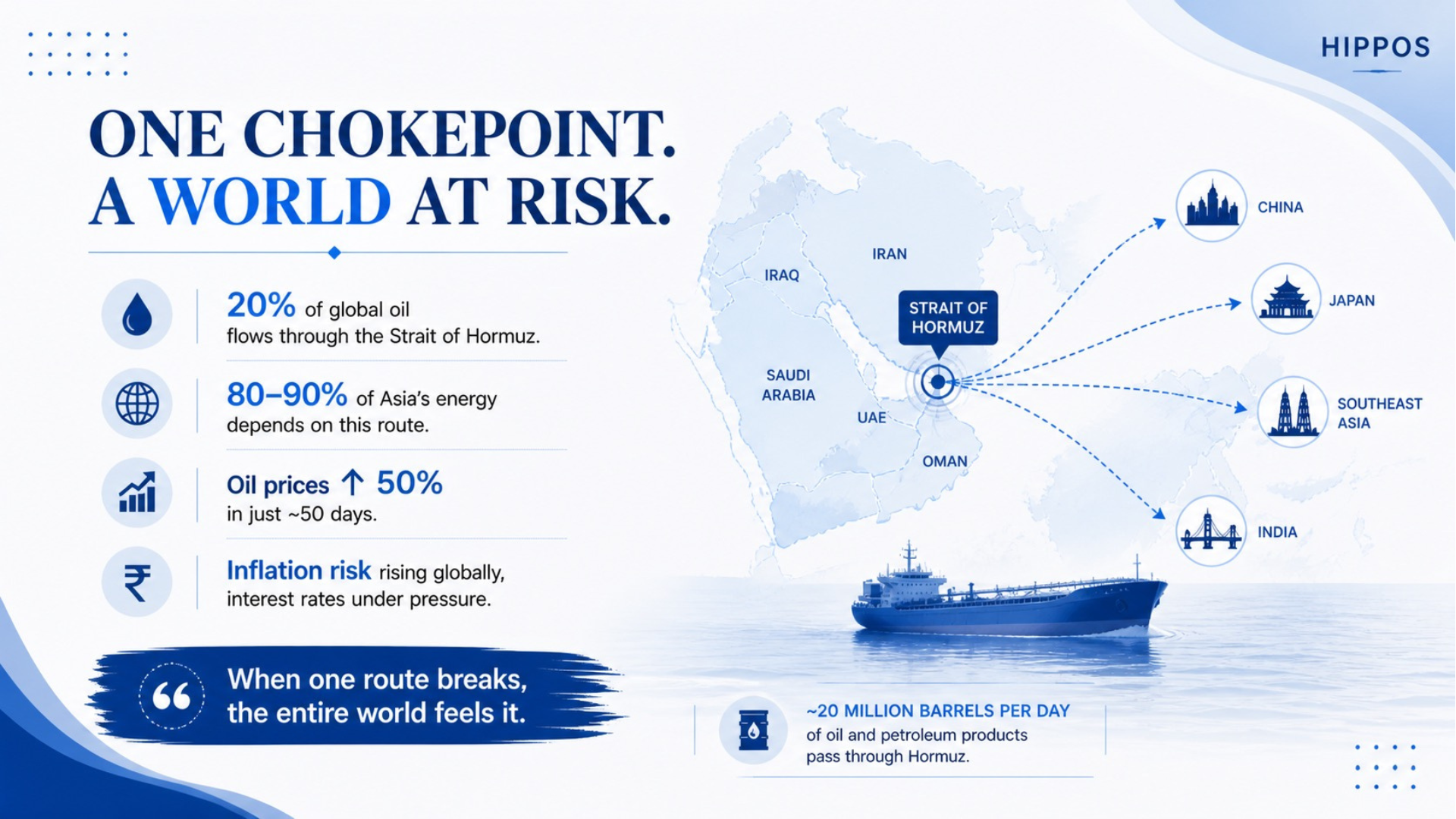
Strait of Hormuz is a very crucial chokepoint on the geopolitical landscape, with 20% of oil passing through the strait and near 80-90% dependence of Asia on the same. Compared to February 27th and now(60 odd days to the war), oil prices are above 50% in prices, the risk of inflation seems to rise, the banks across the world deliberate on raising interest rates, and the pain to consumer market has started to appear with scare of LPG and LNG crisis ensuing. Fiscally governments are scared as their currency starts to get impacted by the war. Industries start to see the burnt as commercial gas gets impacted and rising fear of costs of raw material such as steel and aluminium2 further drive fears around cost cutting, ultimately which impacts workers with layoffs and pay cuts, and which tends to then impact consumer base, further impacting the sovereign stability.
With discussions stalled and ceasefire yet not certain, the crisis still seems to persist.
West Asia as a region and The Hormuz Strait - A strategic chokepoint
The region of West Asia has often been in the limelight of conflicts and wider chaos. A key element which Iran has exploited right now is Hormuz Strait and also the way the region of West Asia has positioned and has been positioning itself midst the world order.
The Hormuz Strait has turned out to be a deterrence held by Iran, much stronger than what a fear of Nuclear Bomb could have provided. A narrow stretch of near 21 miles(33km), this geographical landscape has turned out to be the jugular vein of the entire world economy.
As per the International Energy Agency, approximately 20 million barrels per day (mb/d) of crude oil and petroleum products pass through the Strait of Hormuz, representing over one-quarter of global seaborne oil trade and roughly one-fifth of global consumption. That in economical terms amounts to nearly $600bn (£447bn) worth of energy trade3 per year. Countries in West Asia such as Saudi Arabia hold 10% of global output, Iran holds 5% of global output, Iraq holds approx 4-5% of global output, and UAE a significant member of the Organization of the Petroleum Exporting Countries(OPEC), is amongst the top 10 producers. The OPEC dominance is very visible here as West Asian members of OPEC and OPEC+ (including Saudi Arabia, Iraq, UAE, Kuwait) hold over 23% of the world's proven oil reserves.
Apart from the oil industry the said region shows importance for other raw materials that flow through it. 30-35% of global Fertilizer passes through this region with key nations being Saudi Arabia, Qatar, and Oman. 50% of world’s Sulphur passes through this region, a key raw material in fertilizer creation and also explosives. The said impacts on raw materials and commodities coming from West Asia has hugely impacted Trade Growth which from a rise of 4.6% in 2025 has fallen down to 1.9% in 2026 now as reported by Global Trade Outlook and Statistics - March 20264.
Beyond trade and raw material the importance of this region also stems from the service industry and ancillary developments which have happened here. Tourism also has been accelerated in West Asia, with Saudi Arabia heavily investing in dream projects like Neom and the Line, UAE positioning itself as perfect destination for travel and adventure, and Qatar turning its desert into skyscrapers and football fields for FIFA. The importance of West Asia also stems from the fact that mega infrastructure project IMEC(India Middle East Economic Corridor) was also meant to pass through this region. Dubai also had ended up becoming a key player in the aviation sector5 with civilian airlines’ biggest transmovement being positioned at Dubai.
However this region has always been in a state of VUCA - Volatile, Unpredictable, Complex, and Ambiguous. Volatility stems from the Shia-Sunni split and animosity between the Arabs and Persians. Unpredictability stems from fears and mistrust between Israel and Iran surrounding nuclear and missile programmes. Complexity stems from multiple players like USA, Russia, China, and Asia having their interests in this region. And, Ambiguity exists because of each player in this region having mutually incompatible expectations on growth and security.
This shows how the West Asia and Hormuz Strait have ended up in a situation they are now, and how competing interests and the power held by chokepoints here shape the peace and security of global order.
A brief on India’s dependence to this region
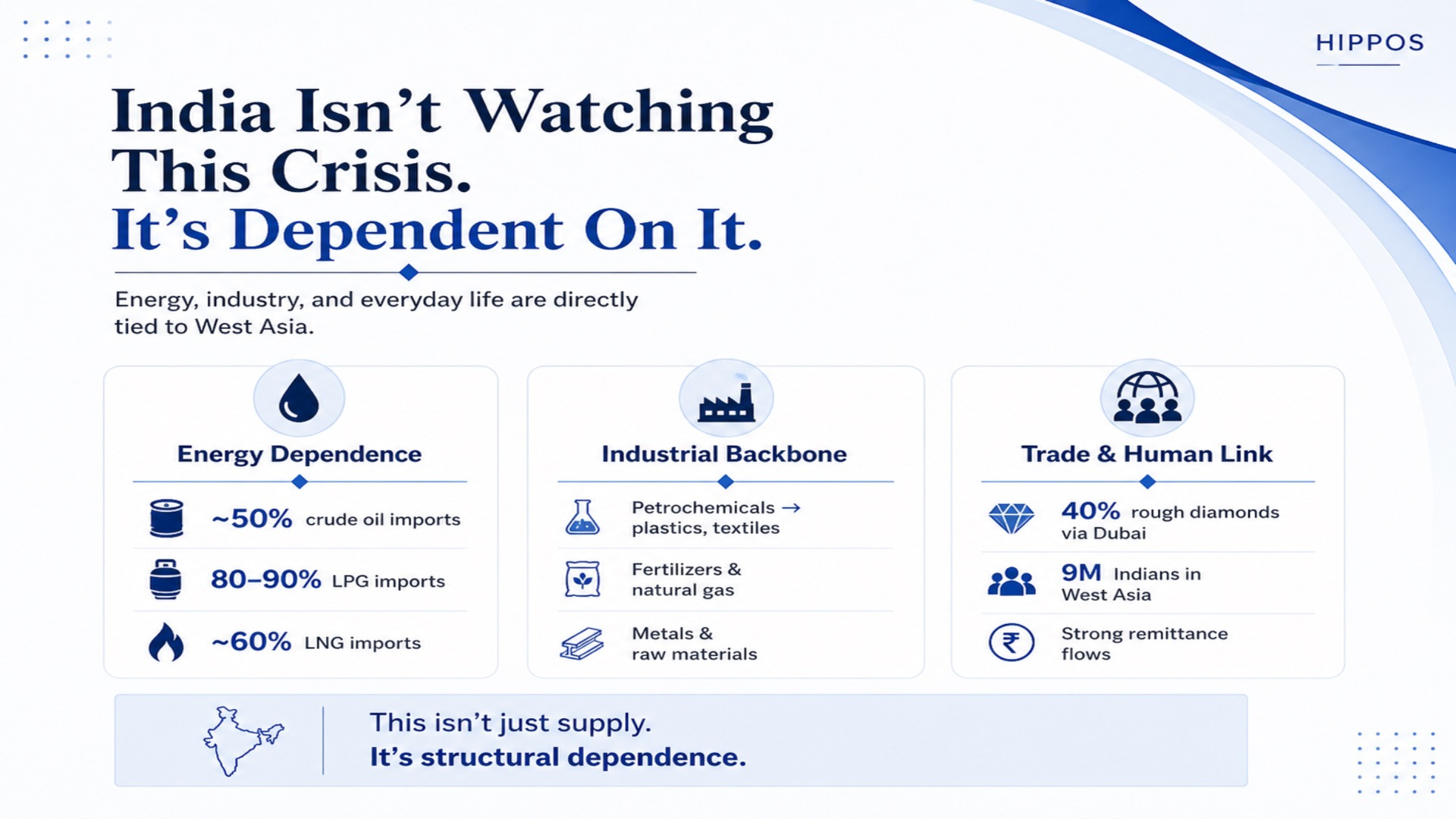
One of the biggest dependence India has from this region is Oil. Around 50% of India’s crude oil6, that means of the imports of oil amounting roughly to 4.5–5 million barrels/day, about 2–2.5 million barrels/day originate from this region. Besides this 80-90% of LPG imports and 60% of LNG imports are sourced from West Asia. This leads to an added pressure onto India at managing its strategic reserves, especially LPG, a source of energy that common men highly rely on. Unlike crude oil, India has limited strategic storage buffers for LPG and LNG, making them more vulnerable to logistical disruptions.
But oil is just one sector. The amplifications go beyond the oil industry. Polymer a crucial byproduct of crude oil is an essential component in many industries, especially packaging and container shipments. India is one of the top leading industries in refining and reshaping of diamond, a raw material in abundance which India gets from West Asia. West Asia is a vital source for India's diamond industry, with over 40% of India's rough diamond imports7 originating from the region, largely through Dubai. The Minerals industry has also seen the impact of the war, India imports nearly 62.1% of Gypsum, 65.8% of Sulphur and Limestone 68.5% from West Asia. These products are essential for fertilizer, cement production, and chemical manufacturing. Fertilizer industry heavily depends on natural gas and imported urea, hence this region again becomes very important for India’s energy security.
Apart from this the heavy metal industry’s raw material also sees its sourcing from West Asia. India imports Direct Reduced Iron (DRI) and raw materials from Gulf producers(nearly 59% imports), which are essential in Electric arc furnace steelmaking and Sponge iron production. Also India imports approximately 25% of its 2 million tons of annual aluminium scrap from West Asia. Unconventional resources like Helium also is heavily imported by the entire world from West Asia, with Qatar being one of the largest helium exporters, a by-product of natural gas processing.
Beyond the oil and manufacturing sector we have people-to-people ties with West Asia. Nearly 9 Million Indians live in the West Asia region8, with huge remittances inflowing. Apart from that dependence of Dubai as trans-hub for flights and tourism adds to the added importance of West Asia for India.
The Dependence of Energy and Daily Essentials of India from West Asia
One of the crucial by product of crude oil sector is petroleum and diesel, a heavy dependence of what we see in the transportation sector, electricity generation, operating machines, and their further refinery provides assistance in even polymer products.
One of the crucial energy source, LPG(Liquified Petroleum Gas) seems it heavy importing from West Asia of the order of 85-90%9 and its usage is in multiple industries. In the form of high intensity portable heat its usage is done in the form of without pipeline gas. LPG is used immensely in metal and metallurgy industry for processing of Aluminium, soldering, and flame usage with regards to heat treatment. In the manufacturing sector it also seems its usage in the Power coating methods, Curing construction, and Moulding methods. Beyond that food processing industry also relies on LPG for cooking biscuits, and roasting coffee and nuts. In textile printing we use them for drying fabric. The agriculture sector also heavily relies on LPG for Weed control, Crop drying, and Irrigation pumping. Beyond that LPG is a commonly used source of cooking fuel by consumers and restaurant industry.
Another key dependence we have is of LNG(Liquified Natural Gas), imported of the order of 60%9 from West Asia, with primary usage in massive energy demand and long haul logistics, such as Power Generation of Primary and Backup form, Fertilizer industry(Natural gas can be refined and processed into Urea), heavy transportation activities, in the processing of chemicals such as Methanol, Ethylene and Propylene, a by product which sees its relevance directly in the plastic and polymer industry. Apart from that another energy sector dependent source is PNG(Piped Natural Gas), used in places which need continuous and uninterrupted supply and hence widely used in Ceramic and glass industry, Paint shop, Manufacturing engineering( Boiler and Furnace usage). Beyond industry it is highly used for day to day activities such as household cooking and water heating.
Fertilizers is also an industry, India is highly and deeply reliant with GCC countries such as Oman, Qatar, Saudi Arabia, UAE, and Bahrain for nearly 75% of India's urea imports10. World’s 30% of globally traded fertilizer products originate from West Asia, and hence underpins the importance of this region for India’s broader economic interests.
Another key importance stems from the raw materials such as Petrochemical Feedstocks (Naphtha, Ethylene, Propene), which see their usage in Plastics (bottles, packaging), Synthetic fibers (polyester, nylon clothes), and Detergents. Another key essential industry is the lubricants and greases These see their usage in everything from your car engine to industrial machinery and even ballpoint pens and lipstick. Candles, crayons, and Coating for chocolates to give them a glossy sheen rely on Paraffin Wax originating from this very region. Petroleum Jelly a byproduct from the oil industry sees its direct usage in Ointments, Creams, and Skincare. Bitumen (Asphalt) a key element in construction and road building sees its origin from West Asia too.
The re-routing of products, delays and rising cost of raw materials
On average oil tankers coming from West Asia via Hormuz Strait used to reach India at Kandla Port in about 37 hours11 and at Mumbai Port in about 53 hours11. Now with the war ensuing our options are 3 weeks of travel time from West Africa by Cape of Good Hope or 40+ days of travel time from the faraway Latin America. This re routing and delays adds pressure to India’s capacity and consumption demands, according to Kpler, India holds around 100 million barrels of commercial crude stocks across storage tanks, strategic reserves at Mangalore, Padur, and Visakhapatnam, and volumes on ships already in transit, providing roughly 40 to 45 days of coverage. So with a stock of such sort, A the reliance fells a lot on to commercial private players, B diversion of LPG/LNG has to be checked and C machine hour rate of industries has to remain stable for longer runs.
The added delay and re routing stress has increased the fear of inflation across the globe, with especially now Central Banks of USA and Europe deliberating on increasing interest rates, the commodity and stock market has also started to see its impact.
As the war still continues and multiple players start to get entangled here, concerns have been flagged across the world, and especially we at India because of our reliance from West Asia.
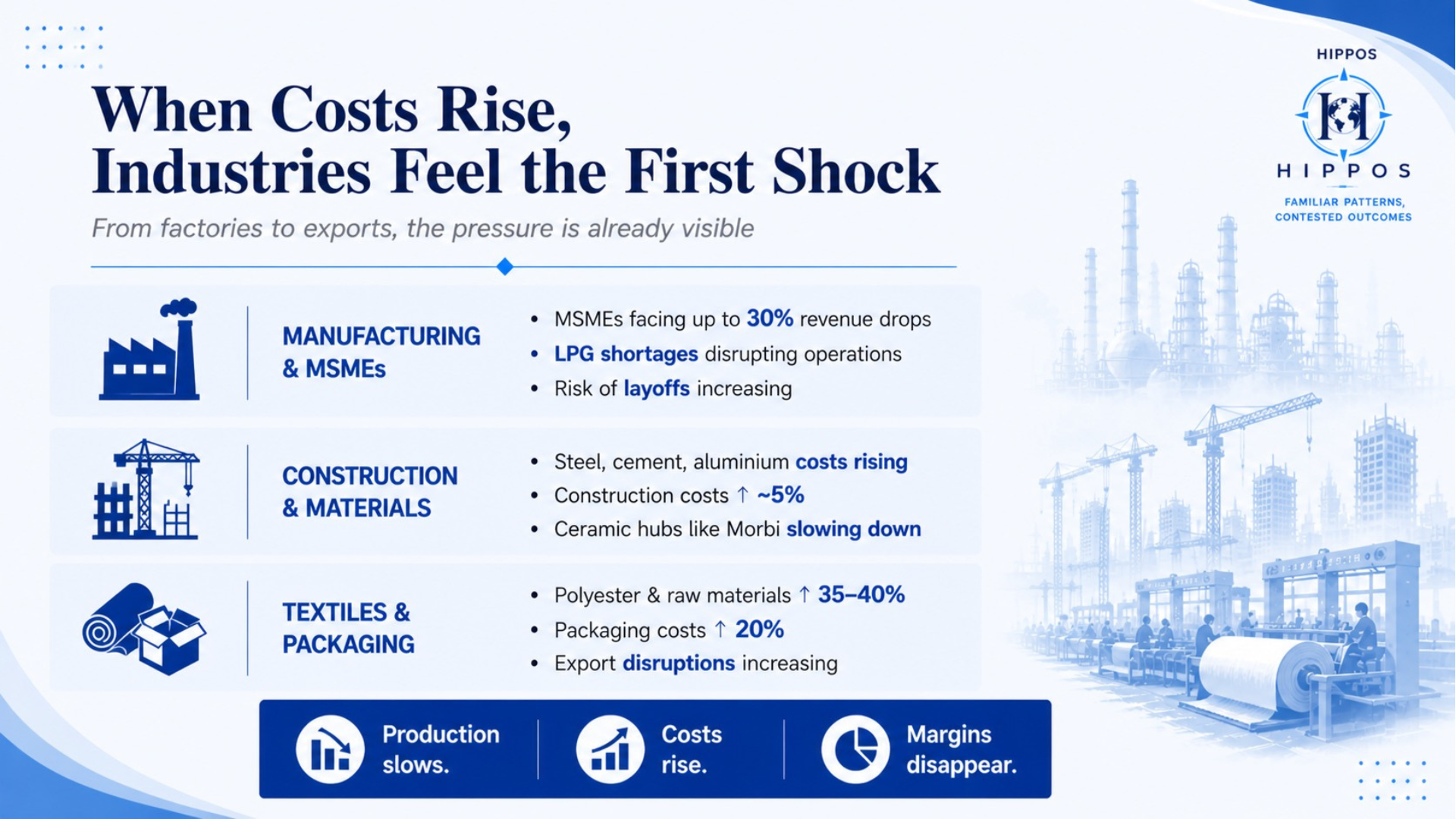
The impact of rising costs on the Industry of India
We can analyze the cost angle on Indian Industries by analyzing the the prominent industry drivers in India.
The Agriculture - Food and Non Food Economy
In a report stated by think tank GTRI, India's agri and food products exports worth USD 11.8 billion to West Asia are at risk as the conflict in the region as a result of disrupting shipping routes, raising insurance costs and uncertainty in logistics. Key shipments include rice, bananas, onions and vegetables, pulses, nuts, coffee, tea and a wide range of spices. An added issue also stems from the fertilizer market. India expects its fertiliser subsidy bill to jump by about 20% for the current financial year, as stated by fertiliser ministry official Aparna Sharma12. India, the world's largest importer of urea, has placed orders to import a record 2.5 million metric tons of the fertiliser at nearly double the price paid two months ago as the Iran conflict disrupts global supplies and drives up prices. This adds pressure on government and the industry of farming as we have heavy reliance on urea usage for agriculture.
Food processing industries rely on use of oil and plastics for packaging, with prices of oil above 50% from the month of February and surging feedstocks of ethylene and maleic hydride, the packaging costs are rising over 20%, forcing companies to increase consumer prices for goods. Industry estimates suggest13 paper packaging costs have risen by about 15 percent, while plastic packaging has seen a much sharper increase of 40 to 50 percent.
Construction and Raw Material for Infrastructure
As the supply chain and import of raw material becomes tough a potential supply chain crisis is being seen as key materials like steel, cement, aluminum, and bitumen are seeing price surges. Even tile and ceramic factories of Morbi have started to slow down. The Morbi ceramic industry, which produces 80% of India's ceramics, has suffered a severe slowdown, with roughly 450 of 600 factories shutting down due to fuel shortages and soaring costs driven by the Iran-Israel war.
With regards to Steel and Aluminum, prices are surging due to logistics bottlenecks, with steel prices in Mumbai adding roughly ₹50 per sqft to high-rise construction14.The construction costs have seen a spike with project costs rising by 5% as supply of limestone and gypsum sees a hit. Shortages are even expected for Bitumen which would amount to slowing national highway construction, with the pace already declining to 23.74 km per day in early 202615.
Apart from reported delays in projects, the developers, particularly in Mumbai, are facing rising input costs that may cause a price hike of over 5% for new residential projects. The situation is leading to a cautious "wait-and-watch" approach among developers, particularly regarding new projects.
Manufacturing sector - MSMEs, Automobiles, and Electronics
One of the key victims to the ongoing conflict also has been the MSME sector especially the ones deeply engrained in the manufacturing economy in the form of Original Equipment Manufacturers(OEMs). MSMEs are integral to OEM value chains, forging, casting, and machining components. Due to shortages of LPG they have started to face the burnt of the war. For example in hubs like Coimbatore, this has caused up to 30% revenue drops and risks large-scale layoffs as inventory runs out. Industry bodies in Rajkot have already flagged logistics cost increases of around 250%16 for some exporters and have started to request relief measures such as port waivers and customs facilitation.
Even the textile industry has seen a significant hit17, primarily causing a spike in raw material prices (especially polyester) and escalating energy costs. Production has dropped, with Indian hubs like Surat facing significant slowdowns, labor shortages, and logistical disruptions. Over 50% of textile exports are affected, forcing industry-wide shifts.
The gas crisis have also hitted the Automobile manufacturers beyond basic raw materials too. For example the paint shop industry18 has started to see the impact forcing major cuts on production schedules. Within painting process a major involvement is of drying and paint curing ovens, which are powered by natural gas. Apart from powering high-temperature curing ovens for baking paint, gas provides thermal energy for air heating and ventilation, and also for thermal oxidation to neutralise paint solvent emissions. Further up post the operations in paint shop you need to neutralize the solvents for which exhaust systems once again rely on natural gas. All of this stalls production lines fearing cost cutting and losses. This potentially can run into 2 ways, rising costs in the petrol/diesel vehicles a lot and other being some favor and push to EVs.
The electronic industry also greatly relies on raw materials like silica, quartz, and helium. Their usage is seen from the chips to Photovoltaic cells to semiconductors to even MRI machines. Hence the war encompasses even unconventional sectors we might sometimes disregard to see.
The impact on services sector
The restaurant economy started to see an early impact to the ongoing crisis. With government protecting consumer houses from shocks and commercial sector taking hit, many restaurants had to take drastic measures. In the first week of the war many hotel associations said supply disruptions linked to West Asia conflict could force up to 50% of restaurants in Mumbai to shut within days.
Many African nationals, Europeans, and even people from West Asia travel to India for the purposes of health care, and hence promoting an industry of Medical Tourism, with the diversions of routes and hub crossing from airports of UAE impacted, an indirect stems to this sector too now. Leading hospitals across the country are reporting a drastic 50% to 75% decline in international patient arrivals19. This sudden drop coincides with the ongoing US-Israel-Iran conflict. Consequently, top hospital chains like Fortis and Apollo are bracing for a prolonged period of uncertainty.
Even the insurance sector seems to see a hit as uncertainty rises and many logistics insurers state that war issues would not be considered for payment of insurance. Premiums for tankers and vessels crossing the Strait of Hormuz have risen to around 3%-5% of vessel value20, compared with 0.2%-0.5% before20 the conflict. In certain instances, ships have reportedly struggled to obtain coverage at all as some insurers withdraw from underwriting voyages through the corridor.
This shows how the impact of the war is much and beyond the primary oil and manufacturing base.
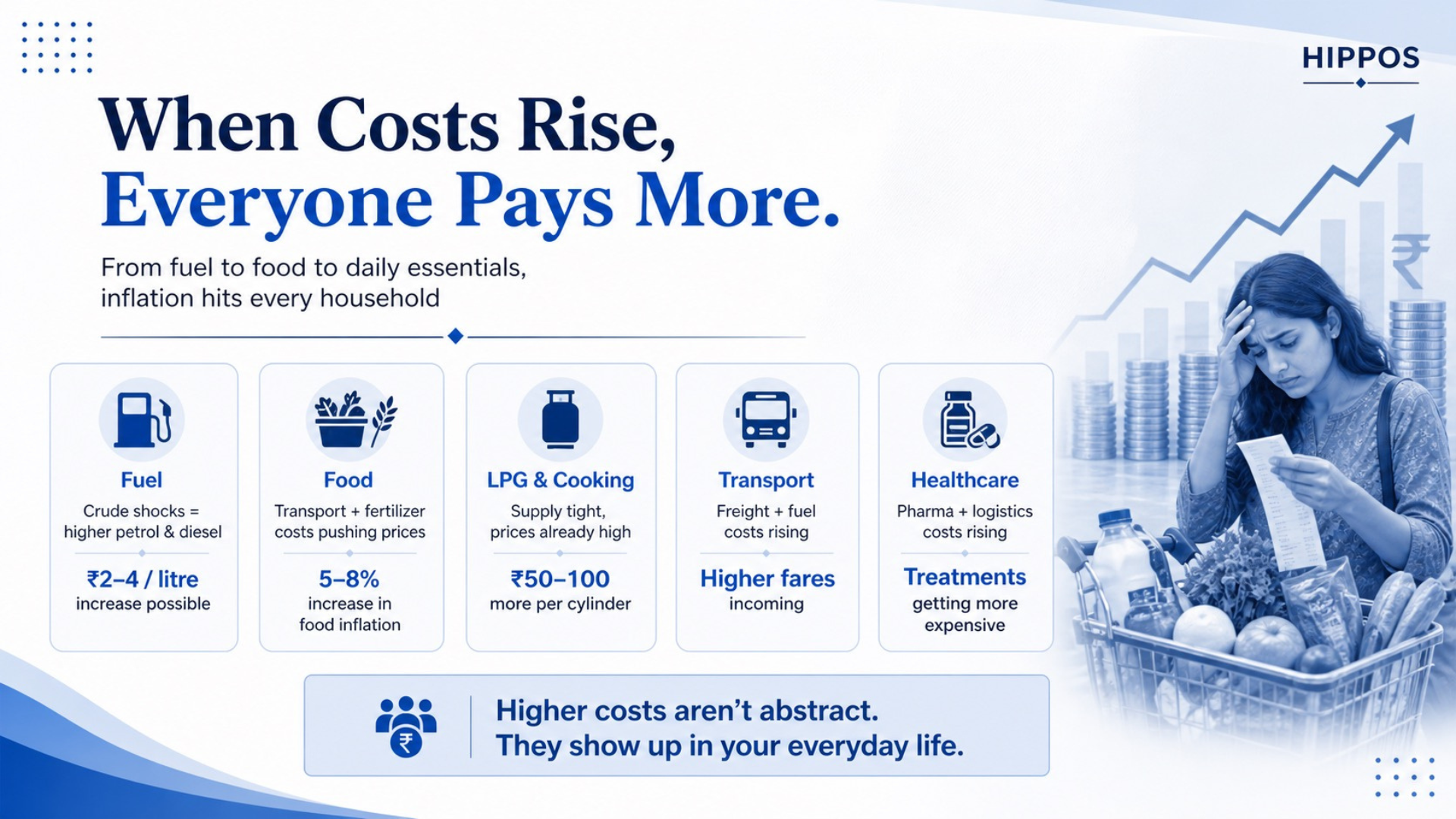
The impact of rising costs on the consumer base of India
A crucial impact is seen with the rising energy needs. As prices of petrol, diesel and LPG increases as crude crosses $85/barrel, monthly fuel spend jumps by approx ₹500–1,500 for households. With impacted trade and imports, the issues around rising commodity costs also start to appear as freight and fertiliser costs rise which ultimately pushes grocery bills up 10–18%.
With rising fear around margin pressure forcing hiring freezes, bonus cuts and redundancies in logistics, manufacturing and startups, the household disposable income would see more drops, impacting saving and investment capabilities. India’s middle class are deeply entrenched in the stock market and trading as retail investors. With rising uncertainty and oil-driven inflation, equity sell-offs has been triggered as retail investors and mutual-fund holders see portfolio value erode and retirement savings face risk.
Power bills associated with the use of electricity and supply of water and gas also as see the impact further drives the living cost and strain in the budget of Indian families.
The Impact of rising costs on the fiscal balance of Indian government
The government has already started to see an impact in its fiscal policy as the war accelerates. To ease the pressure away from consumers, government had cut down on additional excise tax on diesel and petrol ultimately taking a fiscal loss of 1.5 lakh crore21. The depreciation of rupee is another concern which the government faces right now, and despite the fact that RBI has been selling dollars in forwards and spots the rupee keeps on falling, which impacts investment lookout and also raises concern on deficit in Forex reserves.
With import bill rising further and government trying to protect industry too, the current account deficit also has taken a toll. The crisis is expected to significantly widen India’s current account deficit (CAD), likely exceeding 2% of GDP due to surging oil import costs and supply chain disruptions. Elevated crude prices and a depreciating rupee (breaking 95 per USD) create severe pressure on the import bill further.
Another concern which the government faces is in the form of logistical pressure. With pressure to change routes and the impacted delays, additional stress is added onto the government which already had been trying to reduce logistical cost to GDP ratios of below 7-8%.
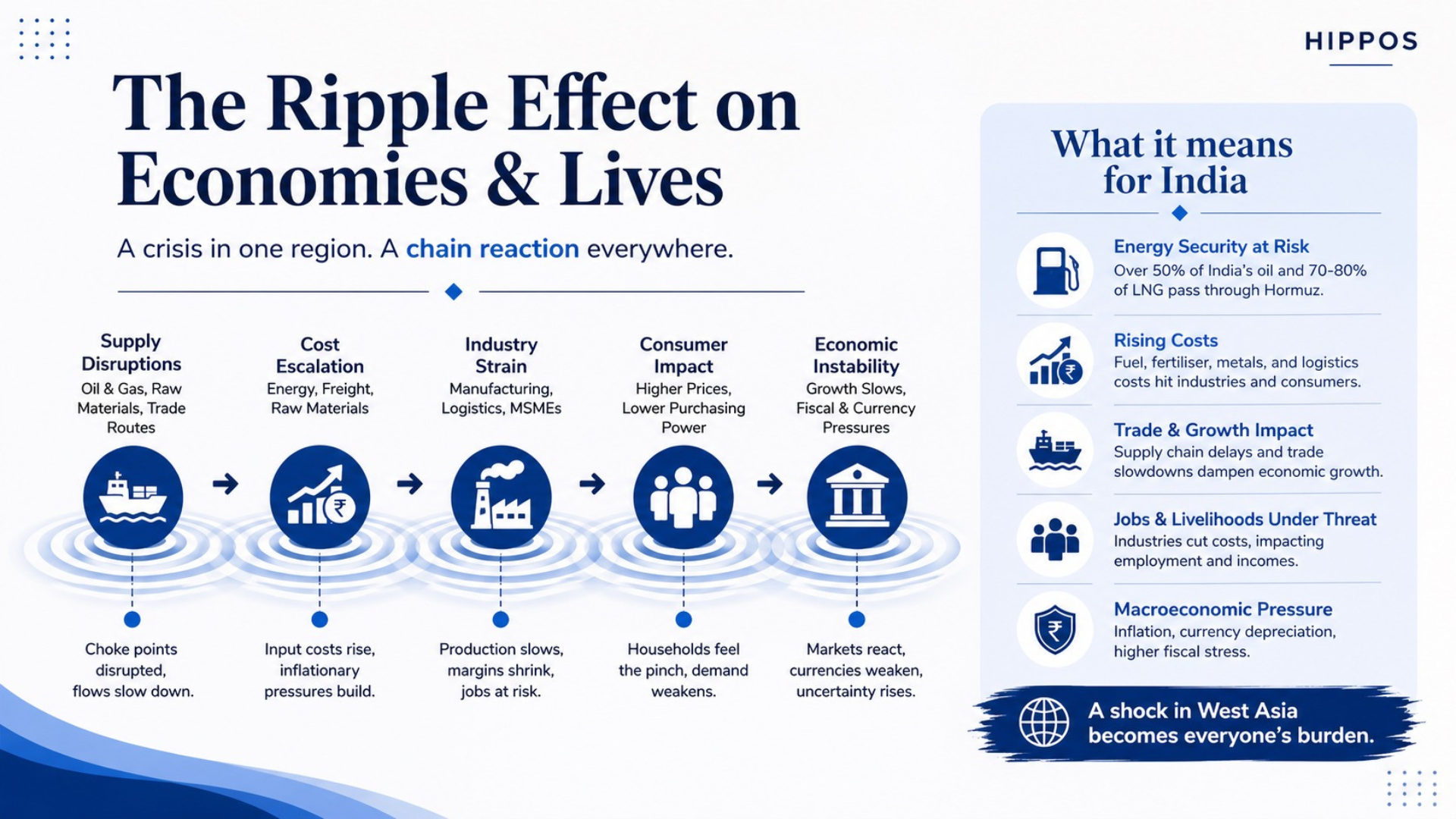
A Vicious cycle of rising cost - Consumer, Industry, and Government
Rising global energy costs trigger a self-reinforcing spiral across India's three economic pillars. Surging crude oil prices push up input costs for industry , from agriculture and textiles to automobiles and construction, forcing companies to cut margins, freeze hiring, or pass costs forward. Consumers absorb the blow through higher grocery bills, fuel costs, and power tariffs, while stagnant incomes and job losses shrink household spending power further. A weakened consumer base reduces demand, deepening corporate stress. The government, caught in the middle, sacrifices revenue by cutting fuel taxes, widens its current account deficit through a swelling import bill, and watches the rupee depreciate, which makes imports costlier still. Each actor's pain amplifies the other's: industry bleeds, consumers tighten, the government stretches, and the cycle feeds itself.
The Geographical Variation of the War on India’s market and economy
The impact of this war has its impacts in different measures across the geography of India in myriad ways depending on the situation and context.
The North India primarily has its economy and market around the agriculture industry and manufacturing bases. With an already impeding Super El-Nino predicted this year and temperature soaring in many locations of North India, a deficit in fertilizer content, and fluctuations caused by electricity shortages for irrigation facilities as diesel prices start to rise, food inflation becomes a risky bet for the entire nation. Key risks include a 15–25% surge in essential food prices22 (grains, edible oils, pulses), compounded by high input costs (fertilizer, freight) and higher crude prices, which might led to RBI’s threshold of 6% rising amid the ongoing issues. Besides that key industrial hubs would suffer as energy prices rises and cost cutting would drive further impact on the labour economy of North India, forcing people back to rural where once again the farming sector would see pressures.
North East was positioned lately as source of investment and infrastructure development by the government. The North East Natural Gas Pipeline Grid (NEGG)23 and the Barauni-Guwahati Pipeline (BGPL), part of the Pradhan Mantri Urja Ganga Project, was meant to import natural gas from West Asia and rest of world and not direct urea to ensure cost saving. With natural gas imports becoming costly midst the war, the said infrastructure and investment projects would be halted. The Western Side of India faces issues of myriad sort. Gujarat’s diamond refining sector gets impacted as raw diamonds becoming costlier, the plan to install solar panels in Rajasthan’s deserts gets stalled as the price of imports of Quartz, Silica, and Helium increases, the financial capital of India, Mumbai faces issues as the stock market tumbles and also gets impacted due to the port business being stalled.
South India in regards to the coastal regions would face losses due to trade disruptions, but beyond that people to people ties is one such arena where they would be many complexities. A significant number of South Indians migrate to the Middle East, with Kerala alone having over a million residents in the region. They are part of the largest foreign workforce in the Gulf, dominated by Keralites and people from Tamil Nadu, working in sectors from construction to engineering. With uncertainty rising their safety and seamless flow of remittances gets impacted as the war keeps on continuing.
The Central India also sees its share of impacts as the oil prices would rise input cost in the mining and industrial corridors would increase. Rising Machine Hour Rate and Transportation Cost would impact Energy intensive sectors like cement, steel, aluminium and cause disruptions in freight and logistics movement. Majority of India’s thermal plants are located here, hence a rising shortage of imported LNG and coal would add more pressure to the grid.
This shows how this war goes beyond the conventional flow and disrupts nook and corner of India’s geography.
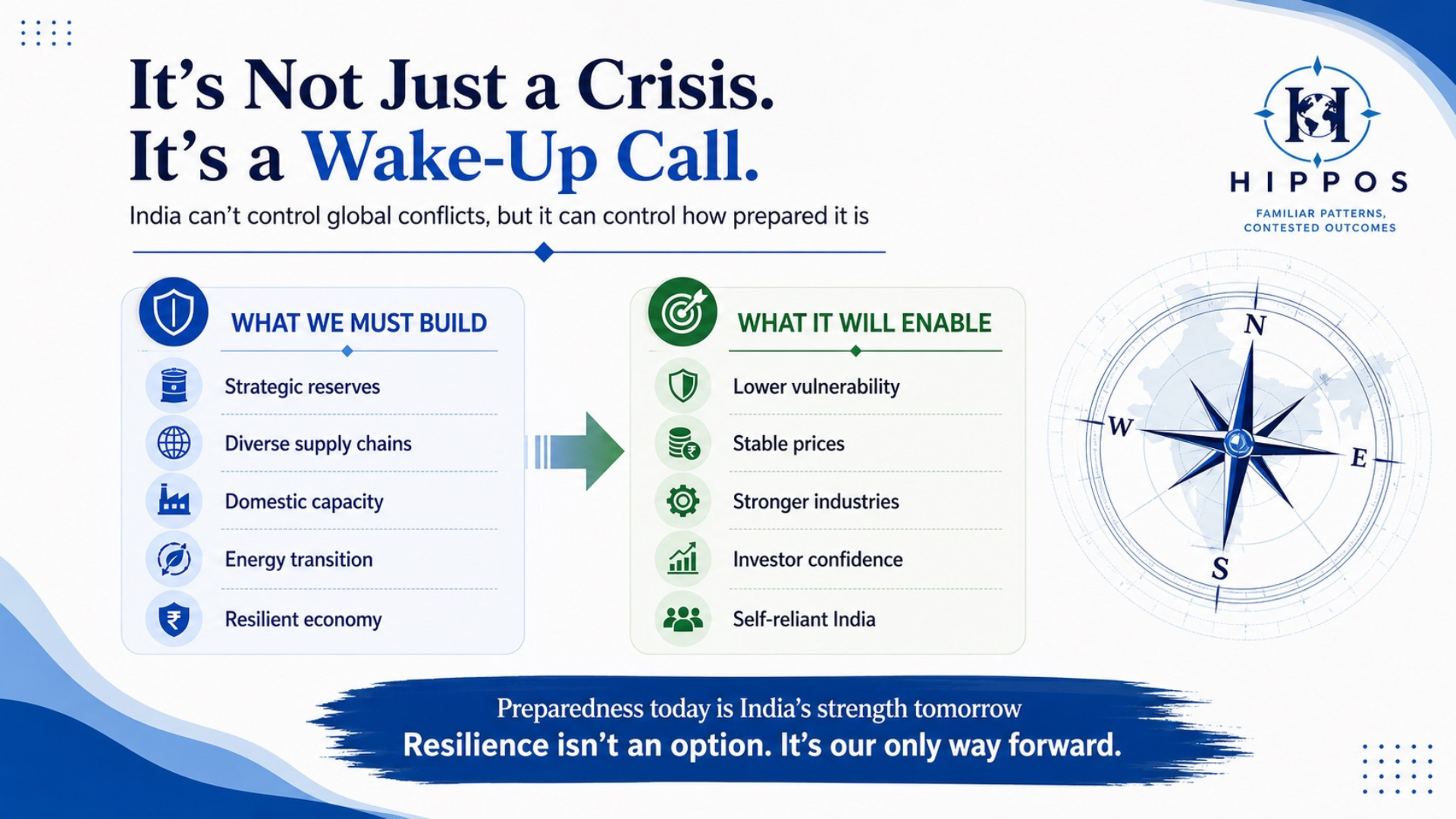
Way Forward for India
Politically India must leverage its strategic non-alignment to negotiate preferential crude supply agreements with Gulf nations, Russia, and Central Asian states, reducing single-source dependency. Domestically, accelerated policy push on PNG city gas distribution, LPG substitution schemes, and fast-tracked renewable energy targets(particularly solar and wind) will ease household energy vulnerability while signalling long-term intent to energy markets.
Economically immediate priorities would include building a better strategic petroleum reserve buffer, diversifying import routes through Chabahar and African corridors, and activating currency swap arrangements to reduce rupee pressure. Fiscal management must balance consumer protection, through targeted subsidies rather than blanket tax cuts, while containing the widening current account deficit. Strengthening commodity futures markets and war-risk insurance frameworks will provide industry a degree of shock absorption.
For the broader society, industries must temporarily absorb margin pressure rather than passing the full cost burden onto consumers, particularly in essential goods. A behavioural shift towards PNG, public transport, and energy-efficient appliances needs to be incentivised through awareness campaigns. Skilling programmes in green energy sectors can simultaneously address potential unemployment from manufacturing slowdowns.
Technological advancement are also needed. India should accelerate cross-border energy pipeline feasibility, for example - the Iran-Pakistan-India corridor remains a long-term strategic option. Domestically, rooftop solar mandates for MSMEs and commercial establishments, coupled with green hydrogen pilots, can reduce industrial gas dependency meaningfully over the medium term.
Administratively India can position itself as an alternative business and events hub, actively attracting conferences, trade expos, and corporate functions that were previously routed through Dubai and UAE. Streamlining port logistics and reducing dwell time at major ports will help partially offset the 250% logistics cost spikes already flagged by industry bodies.
On the legal side easing of business regulations, fast-tracking environmental clearances for domestic energy projects, and creating special manufacturing zones to attract industries relocating from conflict-affected regions will strengthen India's position as a stable, investable destination in an uncertain global environment.
Ongoing discussions for ceasefire and peaceful resolution
It’s close to 2 months now since the war between the Iran, Israel, and USA started. However as the way things stand, alongside the maximalist stance offered by ongoing parties in negotiations and the mistrust and complexity surrounding Pakistan as a resolution maker, things look still unstable and complex for peace. However a debate, discussion, and deliberation under the ambit of falling points might help to solve this issue.
The Strait of Hormuz : Safe passage via cooperation between the Gulf Nations, Iran and a trusted partner for example India(1st responder in the oceans) can try to thaw the issues between the warring faction. The demand of taxation from side of Iran wouldn’t be possible hence cooperation is the safest bet, considering also the fact that there are sea-mines positioned in the ocean, which needs removal.
Nuclear program : Iran currently has no more of it’s Uranium enrichment facilities in operation post tactical attacks by USA and Israel at sites like Natanz, Isfahan, Fordow, and Bushehr nuclear plant. All now is left is 440Kg of Uranium (HEU), for which a consensus in lines to 2015 Joint Comprehensive Plan of Action (JCPOA) was signed, a similar cooperation needs to be envisaged between P5 nations(China, USA, Russia, UK, and France) and Iran, and IAEA for ensuring peace.
Regime change/positioning : Post the assassination of Supreme Leader, the new regime actually is at a much more repressive end. This is where any further hammer to anvil would lead to more reverberations and amplification. No credible power yet exists in Iran to try a regime change, so all that can be done is cooperation, and repairing of ties. Opportunities in form of business often leads to cooperation, so trying Joint Venture for a pipeline between Iran and Gulf nations by reviving Iran-Oman pipeline and a JV opportunity at Chabahar port with India can check to the demands of Iran for investment and reparations.
Removal of sanctions and promises : A removal of sanctions ensued and also the ongoing UNSC resolution provides space and incentive for Iran to carry peace process, and hence removal of said sanctions becomes important. A promise of safety and deliberation between US-Israel-Iran can help ensure peace is maintained not just for temporary ceasefire purposes but actually is sustained for long term. Even from the side of Iran commitments are a must for respecting the sovereignty fo West Asian nations that they bombed through during the ongoing conflict.
Lebanon issue and miscellaneous : The war on Iran, saw the Axis of Resistance activating in Lebanon as attacks from Hezbollah began on Israel. However the current Hezbollah manpower has been decimiated by Israel and the bombing ensued. For a long lasting peace and a possible solution, de-weaponization of Hezbollah becomes more and more relevant with even the civilian administration not supporting them.
For a long lasting peace, discusison, debate, and deliberations are a must but that too with much reliable partners at hand, and not nations like Pakistan which just only want self gratification.
References
Gungor, Y. (2026, March 3). Israel killed Iranian Supreme Leader Khamenei with precision missiles, jammed phones, hacked cameras: Report. Anadolu. https://www.aa.com.tr/en/middle-east/israel-killed-iranian-supreme-leader-khamenei-with-precision-missiles-jammed-phones-hacked-cameras-report/3847420
Argus Media. (2026, April 7). How the Iran conflict is affecting non‑ferrous metals markets. https://www.argusmedia.com/en/news-and-insights/market-opinion-and-analysis-blog/iran-conflict-aluminium-metals-impact
Butler, G. (2026, April 8). Iran war: What is the Strait of Hormuz and why does it matter?https://www.bbc.com/news/articles/c78n6p09pzno
Staiger, R., World Trade Organization, Nee, C., D’Andrea Adrian, B., Koloskova, K., Auboin, M., Gonciarz, T., Verbeet, T., Bekkers, E., Blanga-Gubbay, M., Bhatia, S., Della Coletta, F., Eberth, F., Lundquist, K., Marcus, Y., Mbise, T., Pene, C., Smith, D., To, C., . . . McAdams, J. (2026). Global Trade Outlook and Statistics. https://www.wto.org/english/res_e/booksp_e/gtos0326_e.pdf
User_Name. (2024, September 12). DXB Ranked Most Connected Airport in the Middle East. Dubai Real Estate News. https://famproperties.com/blog/dxb-most-connected-airport-middle-east
Bubna, U., & Bubna, U. (2026, February 25). With 50% of India’s crude imports passing through Strait of Hormuz, concerns mount over US-Iran standoff. ThePrint. https://theprint.in/economy/with-50-of-indias-crude-imports-passing-through-strait-of-hormuz-concerns-mount-over-us-iran-standoff/2863174/
Singha, A. (2026, March 5). India’s $98 billion imports in hot water as West Asia tensions heat up. The Economic Times. https://economictimes.indiatimes.com/news/economy/foreign-trade/india-west-asia-imports-iran-israel-war-united-states-gulf-conflict-oil-lng-fertiliser-diamonds/articleshow/129089516.cms?from=mdr
Alex Travelli. (2026, March 5). 9 million Indians live in Persian Gulf; money they remit home as lifeline under threat. DT Next. https://www.dtnext.in/news/business/9-million-indians-live-in-persian-gulf-money-they-remit-home-as-lifeline-under-threat
India, E. (2026, April 29). India’s LPG disruption highlights energy risks amid West Asia crisis, says Report - Asia Pacific | Energetica India Magazine. Energetica India Magazine, India Energy News, Renewable Energy News, Conventional Power Generation, Companies Guide. . . https://www.energetica-india.net/news/indias-lpg-disruption-highlights-energy-risks-amid-west-asia-crisis-says-report
Damodaran, H. (2026, March 10). Why fertilisers could be the war’s soft underbelly victim for India. The Indian Express. https://indianexpress.com/article/explained/explained-economics/why-fertilisers-could-be-the-wars-soft-underbelly-victim-10571937/
Puri, S. (2026, March 12). Strait of Hormuz to India: How many days do ships take to reach India from the Strait of Hormuz? Who protects ships from drone, missile attacks? News24. https://news24online.com/world/strait-of-hormuz-to-india-how-many-days-do-ships-take-to-reach-india-from-the-strait-of-hormuz-who-protects-ships-from-drone-missile-attacks/772933/
Reuters. (2026, April 27). India expects annual fertiliser subsidy bill to rise by 20%. The Economic Times. https://economictimes.indiatimes.com/industry/indl-goods/svs/chem-/-fertilisers/india-expects-annual-fertiliser-subsidy-bill-to-rise-by-20/articleshow/130553043.cms?from=mdr
Meenakshi.Sharma@timesofindia.com. (2026, April 9). Packaging cost surge hits consumers, disrupts industry order cycles. The Times of India. https://timesofindia.indiatimes.com/city/indore/packaging-cost-surge-hits-consumers-disrupts-industry-order-cycles/articleshow/130123358.cms
Sarkar, S., & Sarkar, S. (2026, March 19). Hormuz blockade drives up construction costs, threatens delays in India’s realty sector. Fortune India. https://www.fortuneindia.com/business-news/hormuz-blockade-drives-up-construction-costs-threatens-delays-in-indias-realty-sector/131413
Chatterjee, S. (2026, April 4). India’s road building, maintenance to suffer due to US-Iran war | India News. Hindustan Times. https://www.hindustantimes.com/india-news/indias-road-building-maintenance-to-suffer-due-to-west-asia-war-101775243997687.html
G, S., G, S., & Chronicle, D. (2026, March 8). Deccan Chronicle. Deccan Chronicle. https://www.deccanchronicle.com/business/freight-costs-surge-250-as-west-asia-crisis-disrupts-exports-1942338
Fibre2Fashion. (2026, April 29). Speakable content. https://www.fibre2fashion.com/news/textile-news/war-causes-production-loss-serious-stress-for-indian-textile-industry-309998-newsdetails.htm
Barik, S., & Sasi, A. (2026, March 27). West Asia war: Paint shops to emission filters, war heat gets to automobile assembly lines. The Indian Express. https://indianexpress.com/article/business/west-asia-war-paint-shops-to-emission-filters-war-heat-gets-to-automobile-assembly-lines-10603461/lite/
Indian medical tourism: War causes 75% drop in patients. (n.d.). Omnicuris. https://www.omnicuris.com/medshots/daily_updates/west-asia-war-impact-indian-medical-tourism
Marine, Aviation War Risk premiums rise as insurers reassess exposure amid Iran war | Lockton. (2024, November 25). Lockton. https://global.lockton.com/in/en/news-insights/marine-aviation-war-risk-premiums-rise-as-insurers-reassess-exposure-amid
NH Business Bureau. (2026, March 27). Explainer: What the excise reduction means for petrol and diesel users. National Herald. https://www.nationalheraldindia.com/business/what-the-excise-reduction-means-for-petrol-and-diesel-users
Ani. (2026, April 15). India food secure overall but exposed to imported inflation in oils, pulses amid West Asia tensions: Deloitte - The Tribune. The Tribune. https://www.tribuneindia.com/news/business/india-food-secure-overall-but-exposed-to-imported-inflation-in-oils-pulses-amid-west-asia-tensions-deloitte/
Indian Oil Corporation Limited, ONGC, GAIL, Oil India Limited, & Numaligarh Refinery Limited. (n.d.). Northeast to have Rs. 6,000 crore gas pipeline grid connecting state capitals [Press release]. https://www.cciindia.org/pdf/Northeast%20Gas%20Pipeline%20Grid.pdf
