
Ami Sonar Bangla Series - Article 1
TUMI KE? AMI KE? RAZAKAR, RAZAKAR! - “END OF MUJIBISM AND THE JULY REVOLUTION”
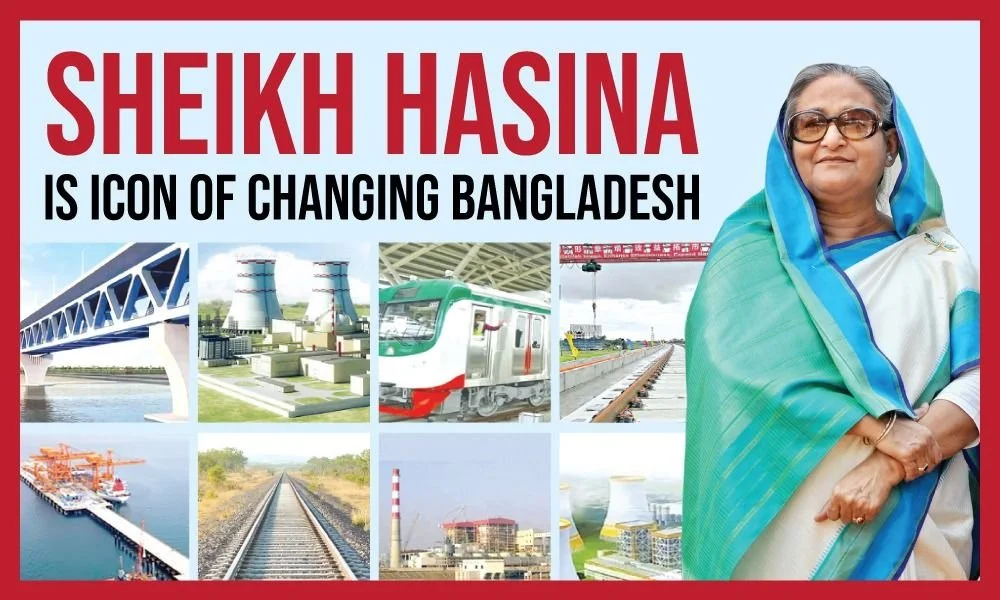
The story of Bangladesh is inseparable from the mythos of Sheikh Mujibur Rahman, Bongobondhu, the architect of liberation, whose vision between 1971 and 1975 sought to anchor the nascent state in socialism, secularism, and linguistic nationalism. Yet, embedded within this founding moment was a paradox that would define the republic’s trajectory: a liberation movement that birthed both a nation and a political inheritance. The assassination of Mujib in 1975 did not merely terminate a regime; it ruptured the ideological spine of the state. What followed - coups, counter-coups, and the gradual Islamisation of politics under figures like Ziaur Rahman and later Hussain Muhammad Ershad transformed Bangladesh from a liberationist republic into a contested ideological arena. Mujibism, as an organizing principle, survived not as a static doctrine but as a political instrument - revived, reshaped, and ultimately monopolised by his daughter, Sheikh Hasina. The “End of Mujibism” in 2024-26, therefore, is not simply about the fall of a leader; it represents the collapse of a state ideology that had, over decades, become indistinguishable from dynastic authority. Bangladesh’s polity evolved into what scholars term a “managed democracy,” where procedural elections masked deep structural imbalances. The removal of the caretaker government provision by Hasina marked a decisive inflection point: elections ceased to be credible mechanisms of legitimation and instead became instruments of regime consolidation. By the 2024 general elections, opposition boycotts, mass arrests, and suppressed turnout (officially 40%, widely contested) rendered the electoral process hollow. Mujibism, in this phase, was no longer an ideological inheritance but a legitimising narrative - deployed to equate loyalty to the state with loyalty to the Awami League. This fusion of party, state, and historical memory marked the transformation of Mujibism into a hegemonic doctrine, intolerant of dissent and deeply reliant on coercive apparatuses.
Credits : Bangladesh Awami League
Paradoxically, this period also coincided with Bangladesh’s celebrated economic ascent. The “development miracle” - driven by export-led growth and positioned the country as a model of Global South resilience. Yet, beneath this narrative lay structural fragilities: overdependence on a single export sector, rising inequality, youth unemployment, and vulnerability to external shocks such as COVID-19 and the Ukraine war. Mujibism, rebranded under Hasina as developmental nationalism, sought to legitimize authoritarian consolidation through economic performance. But as history repeatedly demonstrates, growth without legitimacy is inherently unstable. When inflation bites, jobs stagnate, and currencies falter, the social contract weakens. In Bangladesh, this erosion was compounded by perceptions of corruption cartels, patronage networks, and the conversion of state institutions into instruments of partisan control.
Credits : CNN
By the early 2020s, Bangladesh had entered a phase of advanced authoritarianism. The state’s coercive infrastructure, from the Rapid Action Battalion to digital surveillance laws enabled unprecedented control over dissent. Yet, control bred resentment. Social Media, particularly facebook, emerged as a counter-public sphere. The regime’s attempt to balance secular nationalism with tactical engagement of Islamist groups such as Hefazat-e-Islam further complicated its ideological coherence. Mujibism, once rooted in secular liberation, now coexisted uneasily with theological politics, a contradiction that eroded its moral authority. Even regime insiders conceded the excess: even the only non-Awami winners, “independent” candidates were Awami proxies, or atleast considered so.
Credits : news18
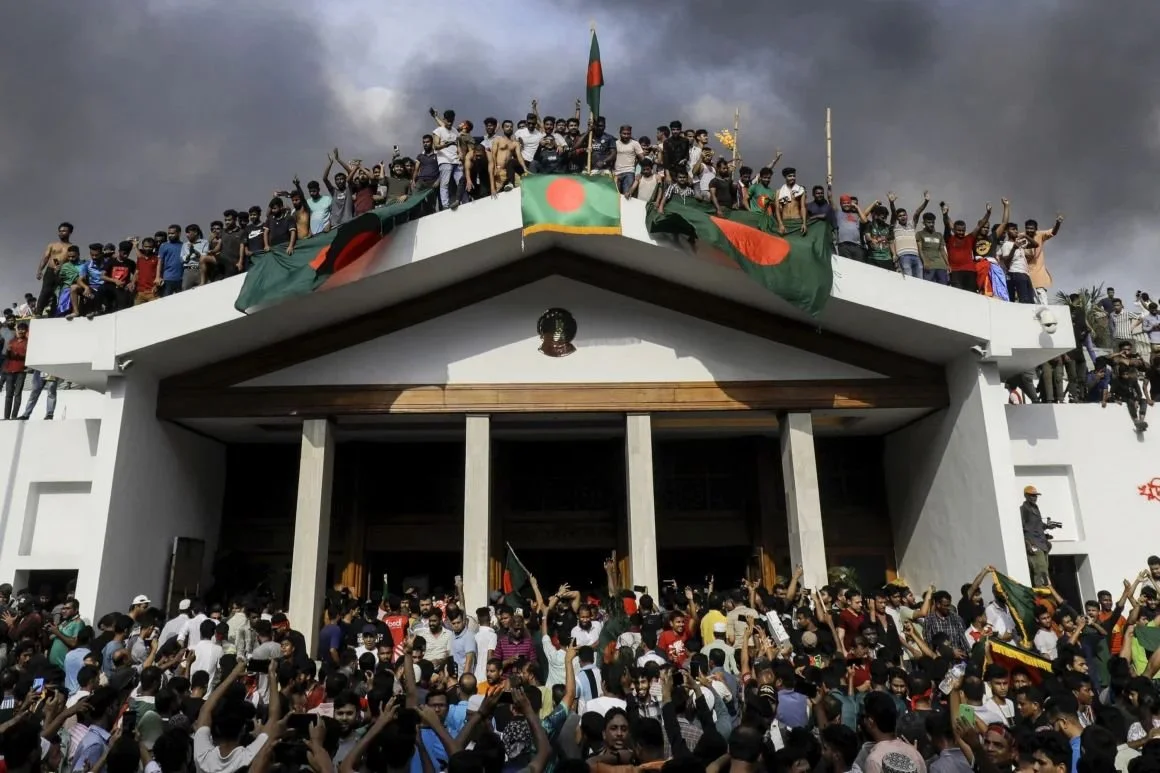
The systemic pressures culminating in the July Revolution of 2024, as a continuation of the South Asian Arab Spring, must be understood as both a spontaneous uprising and a politically mediated rupture. On June 18, a High Court order reinstated a highly controversial 30% quota system for government jobs to descendants of freedom fighters of the Bangladesh Freedom Struggle, allegedly many Awami members, instantly acted as a catalyst for student protests fueled by underlying economic anxiety and rampant youth unemployment. The political opposition through Chhatra Shibir of Jamaat & Chatra Dal of BNP, swiftly capitalized on the genuine student anger. Geopolitical paranoia and external factors complicated the landscape. Recognizing historical vulnerability due to foreign interference & unrobust institutions, Hasina claimed two months prior that a "white country" (widely interpreted as the USA) was attempting to carve out an independent Christian state in the region.
During a highly publicized press conference, Sheikh Hasina made a catastrophic political error. When discussing the quotas, she stated that if the descendants of freedom fighters were not to benefit, would the Razakars be? The students, rather than retreating, weaponized the insult. They proudly reclaimed the slur.
"Tumi ke? Ami ke? Rajakar, Rajakar!"(Who are you? Who am I? Rajakar, Rajakar!)
"Ke boleche? Ke boleche? Shoirachar, Shoirachar!"(Who said it? Who said it? The Autocrat, the Autocrat!)
What followed was horrific brutality in a post-truth digital ecosystem. Competing narratives clouded the violence: some blamed the police, others pointed to the Awami League's student wing (Chhatra League), while some argued Jamaat orchestrated violence to deliberately discredit the government. Regardless of the exact perpetrators, the widespread bloodshed, amplified by the absolute dominance of Facebook in Bangladesh, pushed the nation past the point of no return. The only silver lining remained the professionalism of the Bangladesh Army, unlike the deeply entrenched military apparatus in neighboring Pakistan. A misstep could have easily invited the "Hybrid Pakistan Model", a toxic alliance of the Army, Allah, and America into Dhaka.
Credits : প্রথম আলো ENGLISH
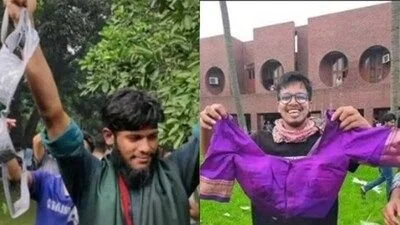
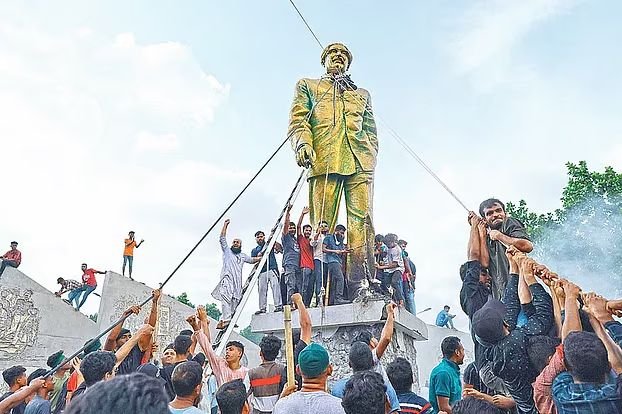
The denouement of this process is encapsulated in the end of Mujibism as both ideology and symbol. The flight of Hasina to India marked the end of an era, but it was the street that delivered the final verdict. The destruction of Mujib’s residence during the “bulldozer march” was not mere vandalism; it was iconoclasm, a deliberate rejection of a sanctified past. The chants of “Fasi Fasi Fasi chai, Sheikh Hasina fasi chai!” (We want execution, we want Hasina’s execution) and “Sara Banglay ek-i khobor, Mujib tui kobore chol!” (The same news across Bengal: Mujib, go to the grave) reflected a politics of negation, where the legitimacy of the founding figure itself is contested. This is unprecedented. Post-colonial states rarely repudiate their founding myths so viscerally. Yet, in Bangladesh, Mujibism had become so intertwined with authoritarian practice that rejecting the latter necessitated dismantling the former. The “End of Mujibism” is thus not merely political turnover; it is a civilisational reset, an attempt to reimagine the republic beyond dynastic memory, beyond managed democracy, and beyond the binaries of 1971.

Credits : Hindustan Times
What emerges next remained uncertain. The revolution framed the beginning of a “Second Republic” which would have tested whether Bangladesh can reconstruct legitimacy on institutional rather than personal foundations. The risk was clear: revolutions that destroy without rebuilding often yield fragmentation or renewed authoritarianism. The opportunity, however, was equally profound. The rise of the 'caretaker government' or an advisor’s government, tested the fundamental ethos of the state again. For now, the verdict of history was unambiguous: Mujibism, once the soul of Bangladesh, had reached its political end. What destiny will the Bangladeshis (or probably the world) shape for themselves? Will Ami Sonar Bangla continue? Turn in for the part two of the series where we will analyse the interregnum.
