
The Silence the Law Permits: Marital Rape in India and the Stalled Progress of Feminism
In India, a man can be prosecuted for raping a stranger. He cannot be prosecuted for raping his wife. This is not an oversight. It is a choice — one that the state has made repeatedly, and most recently in 2023, when it had every opportunity to correct it.
A Colonial Ghost in Modern Law
When India replaced its colonial-era Indian Penal Code (IPC) with the Bharatiya Nyaya Sanhita (BNS) in 2023, implemented from July 2025, there was widespread expectation, at least among legal reformers and women's rights advocates, that the new code would correct one of the IPC's most archaic provisions: the marital rape exception. The government had, after all, presented the BNS as a modernisation, a sweeping overhaul of India's criminal law framework, designed to shed its colonial character and address contemporary realities.
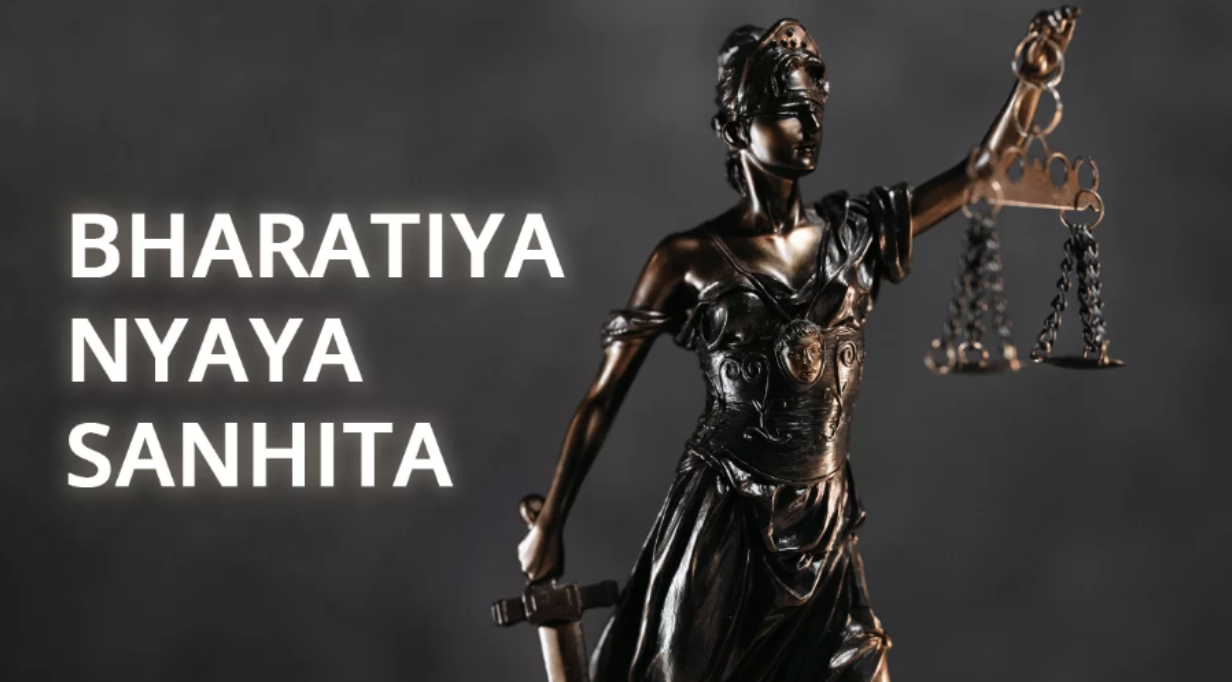
The exception survived. Section 63 of the BNS, which defines rape, carries an Exception 2 that reads: "Sexual intercourse or sexual acts by a man with his own wife, the wife not being under eighteen years of age, is not rape." The language is almost identical to the exception that had existed in Section 375 of the IPC since 1860. In over 160 years of Indian law, through independence, through the Constitution, through multiple waves of women's rights activism, through the Nirbhaya case and the legal reforms it triggered, through the replacement of the entire criminal code, this exception has never been removed.
The exception traces its origin to a doctrine articulated by the English jurist Sir Matthew Hale in 1736, who wrote that a husband cannot be guilty of rape against his wife because "by their mutual matrimonial consent and contract the wife hath given up herself in this kind unto her husband, which she cannot retract." This doctrine, the idea that marriage constitutes irrevocable, permanent, all-encompassing sexual consent, has been abandoned by virtually every legal system that once held it. The United Kingdom criminalised marital rape in 1991. Nepal did so in 2006. But India, in 2023, when it rewrote its criminal code from scratch, chose to retain Matthew Hale's 1736 reasoning. That is not tradition. That is a decision.
The Scale of the Problem
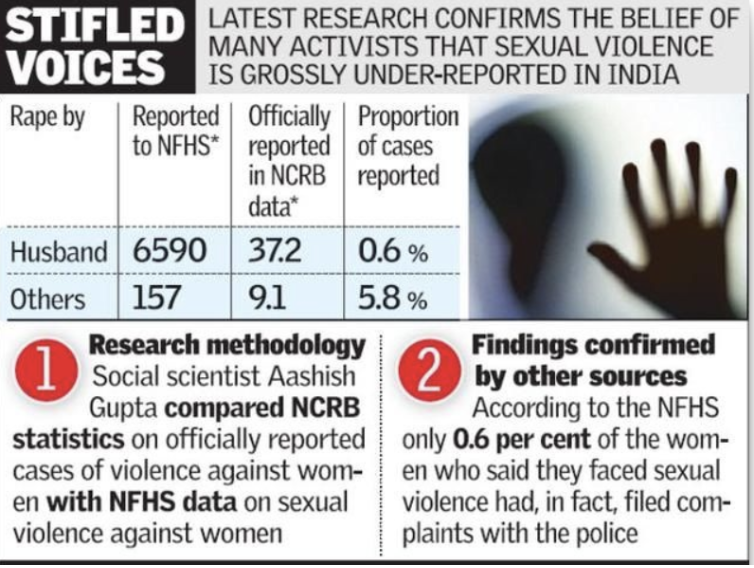
The numbers are not abstractions. They represent millions of women. According to data from the National Family Health Survey (NFHS-5), conducted between 2019 and 2021, one in three married women in India aged 18 to 49 experience spousal violence. The same survey found that over 95% of married women who endured sexual violence identified their husbands or former husbands as the perpetrator, meaning that the most common perpetrator of sexual violence against women in India is the man the law explicitly exempts from prosecution.
The data on non-consent within marriage is equally alarming. Approximately 18% of married women surveyed said they cannot say no to their husbands even when they do not wish to have sexual intercourse. Around 20% of husbands acknowledged they would get angry and reprimand their wives for refusing sex, while 13% admitted they would withdraw financial support as a form of coercion. Given that only about 27% of married women in India are employed compared to 92% of married men, this economic leverage is not a minor factor, it is a structural mechanism by which consent is made impossible.
And yet over 90% of women who experienced sexual violence did not seek help from anyone. Those who did largely turned to family members, their own or their husband's. Not one of them, the NFHS data records, approached a lawyer for legal recourse. Why would they? The law offers them none.

The NFHS survey explicitly cautions against under-reporting, acknowledging that the actual prevalence of marital sexual violence is almost certainly higher than what these surveys capture. The stigma, the economic dependency, the absence of legal protection, and the social framing of sex within marriage as a wifely duty all suppress disclosure. What the numbers show is the floor, not the ceiling.
The Legal Landscape: Contradictions and Half-Measures
The legal framework on marital rape in India is a study in contradictions, a system that acknowledges, in fragments, that a woman's body is her own, yet refuses to draw the obvious conclusion.
The Supreme Court, in the landmark Puttaswamy judgment of 2017, recognised the right to privacy as a fundamental right under Article 21 of the Constitution, explicitly including bodily autonomy within its scope. The Joseph Shine judgment of 2018 struck down the adultery law, and in doing so, affirmed that a woman is not her husband's property. In Independent Thought v. Union of India (2017), the Supreme Court itself held that sex with a wife between the ages of 15 and 18 constituted rape, acknowledging, implicitly, that marriage does not override consent when the victim is a minor. Yet the same logic has not been extended to adult wives.
In 2022, the Delhi High Court delivered a split verdict in Aparnaa Bhattacharya v. Union of India, a case challenging the marital rape exception. The majority affirmed that non-consensual marital sex constitutes a violation of Article 21's guarantees of bodily integrity and dignity, but stopped short of striking down the exception, instead urging "prompt parliamentary intervention." Justice Rajiv Shakdher's concurring opinion went further, explicitly rejecting the concept of perpetual marital immunity as archaic and articulating the concept of "dynamic consent", the idea that consent is not a one-time grant at the altar but a continuous, revocable, situational act.

A fresh petition was filed in the Supreme Court following the Delhi High Court's split verdict. As of 2026, the Supreme Court has yet to hold a hearing on it repeatedly delaying the matter in a way that itself constitutes a form of institutional inaction. In December 2025, Congress MP Shashi Tharoor introduced a private member's bill in the Lok Sabha seeking the criminalisation of marital rape. It has not been passed.
The government's stated position is that criminalising marital rape could "undermine the institution of marriage." This argument, repeated across decades by multiple administrations, deserves direct scrutiny. What it actually says is that the institution of marriage is worth more than the physical safety of the women within it. It says that the legal fiction of a husband's immunity from prosecution for rape is necessary to hold marriages together, which implies, if one follows the logic, that marriages in India depend partly on a wife's inability to withhold consent. That is not a defence of marriage. It is a confession about what some marriages actually look like.
The Feminist Analysis: What Non-Criminalisation Actually Does
From a feminist perspective, the retention of the marital rape exception is not simply a gap in the law. It is a statement, one that the state makes, actively and repeatedly, about the status of women within marriage, within society, and within the republic.
The exception rests on a foundational assumption: that a wife's body is, to some degree, accessible to her husband by right of the marriage contract. This is the logic of coverture, the centuries-old legal doctrine that upon marriage, a woman's legal identity merges with her husband's, extinguishing her individual rights. India formally abandoned coverture when it adopted its Constitution in 1950, guaranteeing equality before the law. But the marital rape exception preserved coverture's most intimate expression: the idea that a wife cannot be violated by her husband, because she is, in a meaningful sense, his.
Feminist legal scholars have long argued that law is not merely a neutral arbiter of existing social norms, it actively shapes them. When the state declares that non-consensual sex within marriage is not rape, it does not simply fail to punish an act. It normalises that act. It signals to every husband, every police officer, every judge, every doctor, every mother-in-law, and every woman who is suffering that what is happening to her either does not exist as a crime or does not rise to the level of seriousness that demands legal attention.
This normalisation has cascading consequences. Women who experience sexual coercion within marriage are less likely to name it as violence when the law does not name it as violence. They are less likely to seek help from family when family has been told, by culture and by law, that this is a marital matter. They are less likely to approach the police when officers can only invoke civil remedies under the Protection of Women from Domestic Violence Act, 2005, a law that provides some civil protections for marital sexual abuse but explicitly does not create a criminal offence. They are less likely to leave when leaving requires financial independence that structural inequality has denied them.
The feminist framework illuminates something else, too: the selective application of consent in Indian law. Consent is legally required, and its violation is criminally punishable, in virtually every other context involving a woman's body. A stranger who forces sex faces prosecution. An acquaintance who does the same faces prosecution. An employer, a person in authority, even a man who makes false promises of marriage, all are covered by law. Only the husband is exempt. The law, in effect, says that consent matters everywhere except in the institution to which women have been historically most confined. This is not an accident of drafting. It is the architecture of patriarchy expressed in statute.
The Obstacle to Indian Feminism
The non-criminalisation of marital rape does not merely reflect the stagnation of Indian feminism, it actively produces it. It creates a ceiling that feminist progress in other domains cannot break through.
Consider what Indian women have achieved in recent decades, in spite of this exception. The Nirbhaya case of 2012 triggered the most significant reform of sexual assault law in independent India's history, resulting in the Criminal Law (Amendment) Act of 2013, which expanded the definition of rape, introduced new offences, and dramatically increased penalties. The #MeToo movement, though uneven in its reach across class and caste, opened a national conversation about sexual violence and workplace harassment. Constitutional jurisprudence has progressively affirmed women's rights to bodily autonomy, privacy, and dignity. More women than ever before are in higher education, the workforce, and public life.
And yet, inside the institution of marriage, where the majority of Indian women spend most of their adult lives, and where the NFHS data tells us the most prevalent form of sexual violence occurs, the law offers no criminal protection against sexual coercion. The progress is real, but it stops at the front door of the home.
This creates what might be called the privatisation of women's subjugation. As Indian feminism has pushed back the boundaries of acceptable violence in public life in workplaces, in universities, in streets, the home has remained a zone of legal impunity. Patriarchal structures that can no longer be defended in public retreat into the private, and the law, by declining to follow, becomes complicit in that retreat. The marital rape exception tells women, in effect: outside the marriage, you are a full legal person. Inside it, you are not.
This has particular salience in the Indian context, where marriage remains a social imperative for most women across class, caste, and community, and where women's ability to exit marriages is constrained by economic dependency, social stigma, family pressure, and the persistent absence of adequate support systems for separated or divorced women. For the millions of women who cannot simply leave a coercive marriage, the absence of legal protection within it is not a technicality. It is the whole reality of their lives.
The Arguments Against and Why They Fail
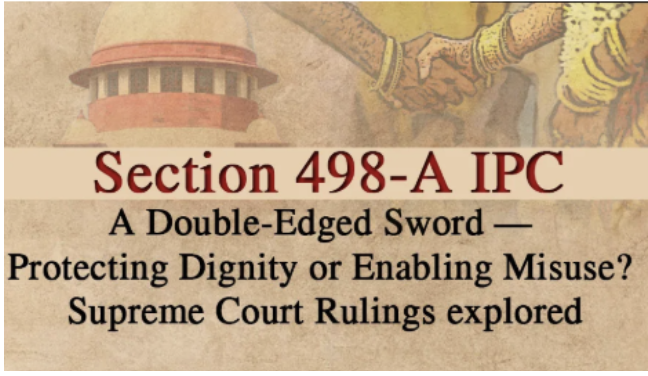
The standard arguments against criminalising marital rape in India deserve engagement, because they are genuinely held by a large section of the population, including many women. They are also, on examination, insufficient. The most common argument is that criminalisation would be misused, that women would weaponize marital rape allegations against husbands in matrimonial disputes. This concern is not absurd. India's legal history includes documented cases of misuse of other gender-specific laws, particularly Section 498A IPC (cruelty to wife), which led to Supreme Court guidelines in 2017 to prevent arbitrary arrest. Safeguards are necessary and appropriate.
But the "misuse" argument, taken to its logical conclusion, would justify stripping the law of most protections for women. The possibility of false accusations exists in every area of criminal law; it is not a reason to deny legal protection to an entire category of victims. Procedural safeguards, evidentiary standards, and judicial oversight can address the risk of misuse without leaving millions of women without legal recourse against a real crime. Several legal experts have proposed frameworks that would include mandatory preliminary investigation before registration of an FIR, counselling requirements, or a fast-track court mechanism all ways of building safeguards without preserving impunity.
The second argument, that criminalisation would destroy the institution of marriage misunderstands what institutions are for. An institution that requires, as a condition of its survival, that women be unable to refuse sex to their husbands is not an institution worth preserving in that form. More to the point, it is empirically untrue that criminalising marital rape has destroyed marriage in the over 100 countries that have done so. In the UK, in Canada, in South Africa, in Nepal marriage continues. What changes is the power dynamic within it.
The third argument is cultural, that Indian marriage operates on different assumptions than Western liberal frameworks, and that imposing criminality would be an imposition of alien values. This argument romanticises the status quo. It says, in effect, that Indian culture's authentic expression includes husbands' right to force sex on their wives, and that Indian women who object to this are somehow acting against their culture. This is not a defence of Indian culture. It is a defence of one strand within Indian culture, the patriarchal one, against the women within it who have been saying, for decades, that this is not acceptable.
What Criminalisation Would Mean
The feminist case for criminalising marital rape is ultimately simple: women are full human beings, with an equal right to bodily integrity and sexual autonomy, whether they are married or not. Marriage is not a contract for unlimited sexual access. Consent is not given once at a ceremony and held in perpetuity. Every act of sex requires the active, continuing consent of both parties, and when that consent is absent, the law should name what has happened and provide recourse to the person harmed.
Criminalising marital rape would not solve everything. Reporting rates would remain low, at least initially. Conviction rates would face the same evidentiary challenges that plague all sexual assault prosecutions in India. Social attitudes would not change overnight. But the law has a signalling function that extends far beyond its enforcement. A law that says marital rape is a crime tells every woman in India that her body is hers, even in marriage. It tells every husband that sexual coercion is not a right. It tells every police officer, every doctor, every family member that dismissing these complaints as "family matters" is no longer a legally defensible position.
It would also, finally, bring India into alignment with its own Constitution, a document that guarantees every citizen equality before the law, liberty of person, and dignity. As the Delhi High Court majority noted in 2022, the marital rape exception sits in direct tension with Article 21 as interpreted by the Supreme Court in its own jurisprudence. The Constitution already protects what the exception denies. The legislature simply needs to acknowledge it.
Conclusion: The Law We Do Not Have
Indian feminism has won significant battles. It has changed laws, shifted conversations, produced leaders, and slowly, unevenly, altered the social landscape. But it continues to confront a ceiling embedded in the one institution that has always been central to the control of women's lives and bodies: marriage.
The marital rape exception is not a remnant of the past that simply hasn't been cleaned up. The BNS made a deliberate decision to keep it in 2023. The Supreme Court has made a deliberate decision to not hear the petitions challenging it. Parliament has not acted. At every level of the state, this choice is being remade, continuously, in the face of evidence, argument, and constitutional jurisprudence that all point in the same direction.
Until that changes, the feminist promise of Indian law, that women are equal persons under the Constitution, will remain partial. Equal everywhere, except in the bedroom. Protected from everyone, except the husband. Recognised as autonomous, except where it matters most. A law that cannot name what is happening to one in three married women is not a just law. It is a silence, and the state's silence, in the face of known violence, is its own form of complicity.
Reportings and legal analysis from Legal Service India, Record of Law, the Endocrine Society, Equality Now, Feminism in India, the National Family Health Survey-5 (2019–21), and the Delhi High Court's 2022 judgment in Aparnaa Bhattacharya v. Union of India.
