
How the Warming World is Failing Women
From care to casualties, the escape routes look narrow
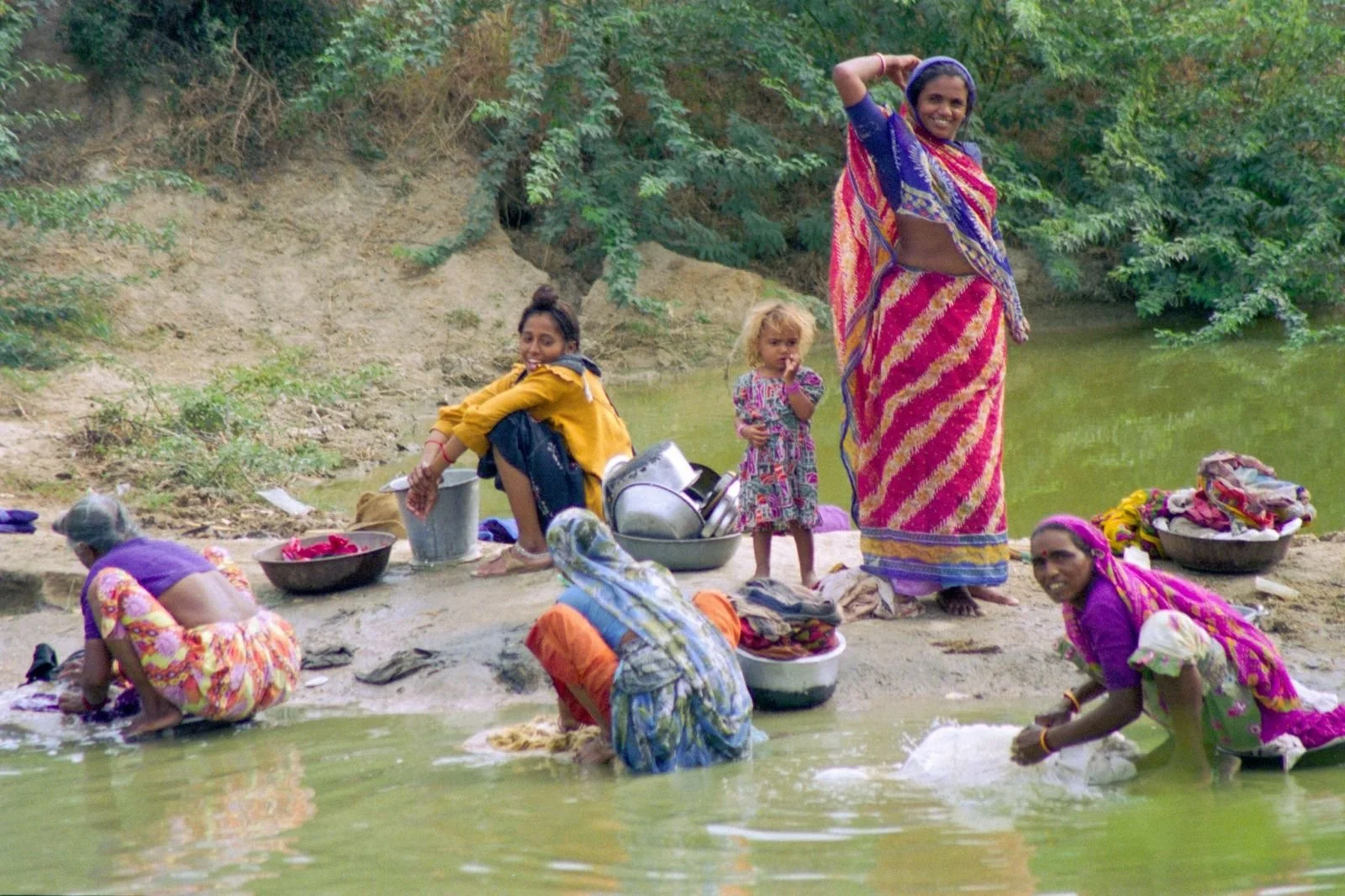
In the outskirts of a small village, a group of women sat peacefully with rice kernels and wheat baskets. What began as a daily chore would turn into a blissful rendezvous. The dawn felt calm, and by the time the kernels were segregated, a warm cup of tea at dusk was the perfect wrap-up.
But today the dawn burns like the kitchen inside the mud house, and dusk comes with stress and fatigue. Spring started earlier and earlier, and summers peaked before their time; the air inside their kitchens choked, and the peace once sought outdoors became intolerable heat.
Women who have always been close to nature, as tillers, caretakers, and as compassionate human beings, are now at the forefront of the poison that we wrap in terms like “climate change”, “heat waves”, “ecological overshoot”, and “death of an ecosystem”.
Every day as we get more and more acquainted with the jargon of ecology, its victims slip more and more into ignorance. Women shoulder the responsibility of securing food, water, and energy in most communities. When the man of the house works in factories, the woman is not just responsible for taking care of the farm but also for cooking, fetching, and surviving.
Women and girls are more susceptible to climate change than men. In times of disaster, this study confirms that women are 14 times more likely to die than men. Women are not 14 times weaker than men. Still, the pressures on them, the burden of household work, less mobility, lack of awareness, and above all, patriarchy rooted in tradition, restrict their ability to act in times of disaster.
Often leaving them behind, quite literally trapped.
The bias we ignore
The 2004 Tsunami on the East Coast of India is a glaring example of how women were more vulnerable than men to climate disasters; out of the 23,000 killed, 70% were women.
Women impacted by extreme events. Source: Carbon Brief
UN Women reports that by 2050, 158 million more women and girls will succumb to poverty, and 232 million will face food security risks. We have already seen the climate policy pendulum swing between the Kyoto Protocol and the Paris Agreement, and COP30 and its magnificently useless achievement. Well, the last time the formal focus on health was in COP28.
We are on the verge of crossing several tipping points. A country has almost drowned, and if this trend continues, we know Tuvulu will drown before the US, African farmers will migrate before their European counterparts, and tropical species will be extinct before we know it.
But what we often miss is the gap between these lines. The women in Africa are more repressed compared to their male counterparts. Their abuse when it comes to migration and survival is more likely. If you think that’s worse, this WHO document further confirms: theimpact of climate change on Women’s bodies is underreported and underestimated.
Repression, poverty, lack of accessibility and awareness are why this is magnified. It gets worse when, during disasters and extreme events, access to health supplies is cut. Women suffer disproportionately: Menstrual health is compromised, and often, many women are forced to use improper menstrual products, creating further complications.
When a pollution conference in a seven-star hotel discusses policies to curb the menace without even naming the real culprits, they ignore that in the villages of underdeveloped nations, the difference between the impact of pollution on men and women is almost fivefold higher.
Climate migration, which finds its mention in every policy document, but somehow remains underreported and chaotic, is also impacting women more than men, 80% people who migrate due to climate change are reportedly women.
A disaster unfolding
We mistake climate change for a future event. This will one day kill us, or humans will die of climate change. The “will” is the problem. The truth is, we are already breathing air that is polluted with particles that are running inside our blood.
When the word disaster is attached to any event, it gives us an assumption that something is about to happen; it’s like reserving a shelf for the fear of the upcoming. But this, my friend, has already manifested around us, everyone, men and women, with the difference of degree and multitude are living in this reality.
A new study found that in heat-stressed regions, women face unique health risks. Women surveyed from seven High Heat Vulnerability index districts 70% reported dizziness, fatigue, dehydration, and higher stress.
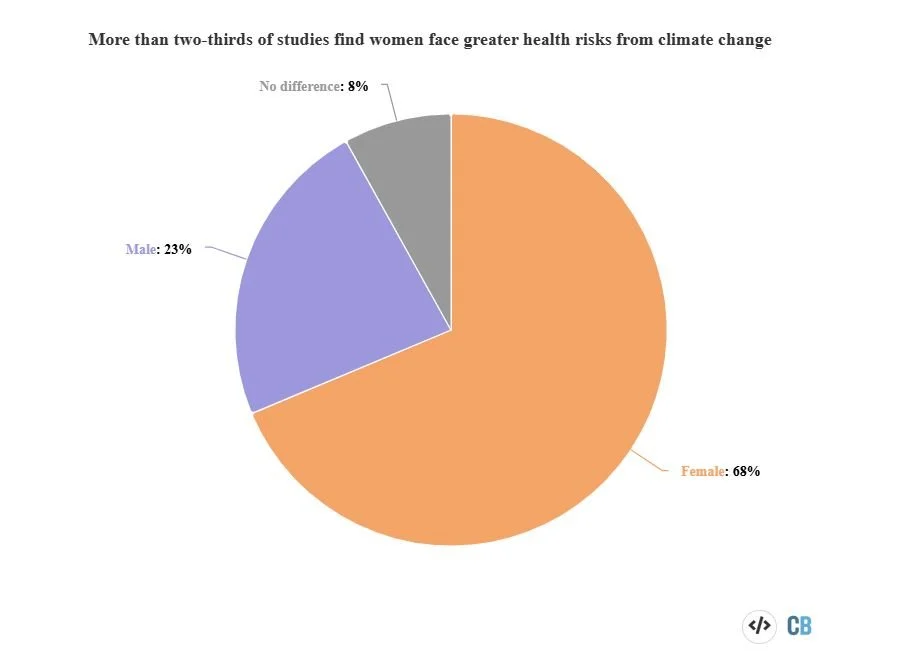
In 89 out of 130 studies, Carbon Brief concluded that climate change affected women more than men. In almost all indicators, women are more prone than men, and maternal health is an even more traumatic experience.
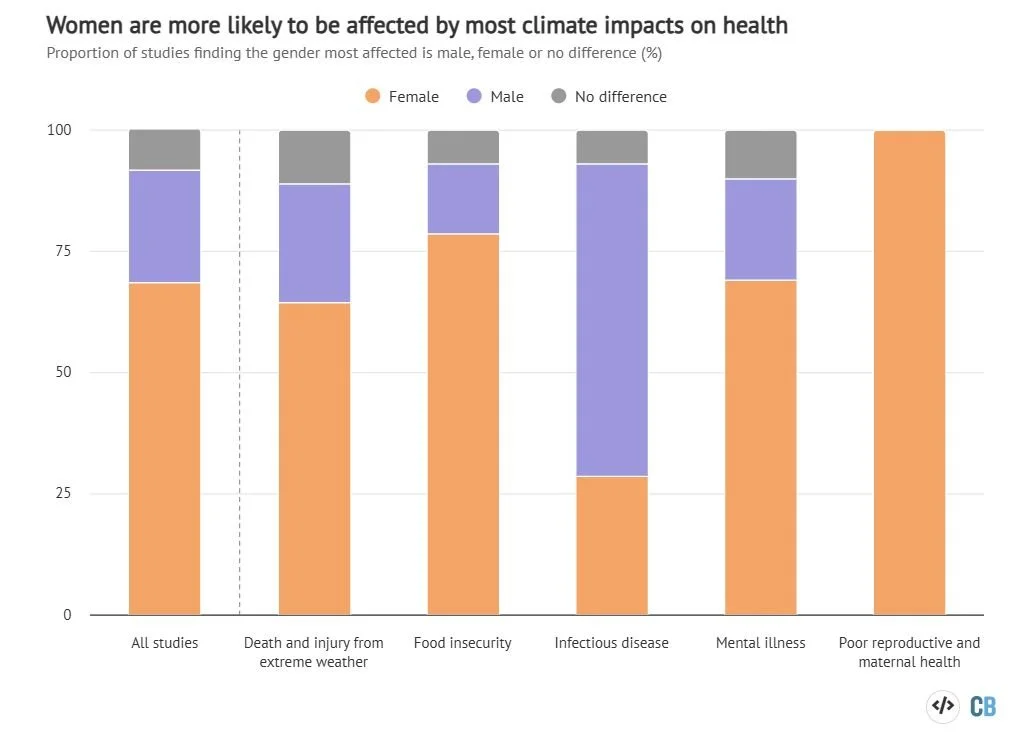
The impact of different events on men and women. Source: Carbon Brief
Every day in the summer, I felt the burden of the weather on my mom and me. Periods became worse, and cramps hurt more as the heat outside became unbearable. In 2024, when we witnessed the warmest year on record, heat waves in North India made me shift my apartment twice.
Similar experiences are faced by several thousand women, but they are either ignored or misinterpreted as “normal”. The problem with the unequal impact of the climate crisis on women is the sheer lack of acceptance that it is unequal.
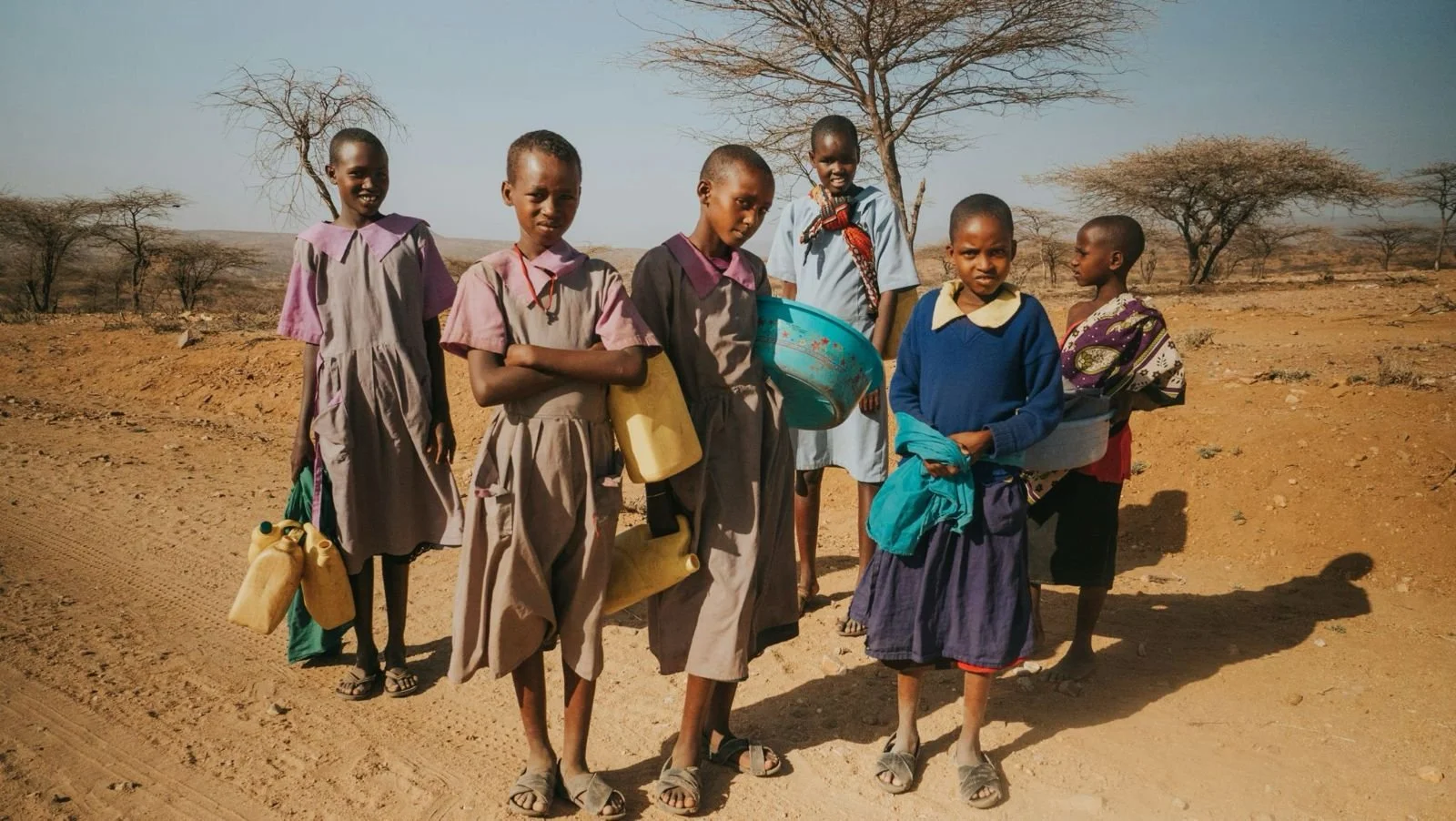
When droughts in Kenya struck in 2022, women were hit by malnutrition and dehydration far more than men. Not only this, but women-specific crimes: genital mutilation, rape, violence, and child marriage rose.
This goes beyond extreme events. Forget hurricanes and droughts, heat waves, which are as common as oxygen we breathe, microplastics, sorry, are negatively impacting menopausal systems and stress related to childbirth. A series of studies showed that women in France are more likely to die in heatwaves when compared to men.
So what we are witnessing is not scattered events, but a sequence of them.
The caretakers we need
Women have what it takes to nurture. I was touched by the story of an 85-year-old lady from India who cried after a Peepal tree she planted was brutally cut down. Neighbours recorded how she cared for it like her own child, worshipping it every day.
Imagine if the 85-year-old who cried for the lost peepal tree was given resources to plant more trees. Her efforts would have provided shade for the women who tilled the land in the scorching heat.
Or the Chipko movement, where women hugged trees to prevent them from being cut down. And the women contributing 50% of the world’s food production. The FAO designated 2026 as the Year for Women Farmers — The State of Food and Agriculture report suggests that if women had the same resources as men, crop yields could go up by 20 to 30% while feeding an additional 100 to 150 million people.
The UN Secretary General emphasised that “If we leave anyone behind, we leave everyone behind”. Reinstating the importance of women at the core of climate policy. The Gender Equality in Climate Action report stresses four action-oriented approaches for involving women in climate action:
Action 1. Strengthening the accountability for gender equity strategies in economic and financial practises.
Action 2. Intensifying sustainable practices at the ground level by allocating and reorienting funds to improve women’s access to resources. Women’s potential in financial management is still unleashed, but through the ever-expanding microfinance networks, giving them credit access can be the bridge to bring them from the state of victims to active problem-solvers. The private sector can help provide technological support and ensure capacity building through stakeholder engagement, which will help scale income generation through higher value chains.
Action 3. Including gender issues in biodiversity and climate commitments through scalable initiatives. In Odisha, a non-profit organisation launched a food security programme for women with the help of SHGs, and by implementing micro farm-oriented projects in several malnourished districts of Odisha, it not only tackled the notions that prevented women farmers from active involvement, but also helped them become self-sustainable.
Action 4. Lastly, capacity building by strengthening dialogue with multi-stakeholders for more gender-equitable opportunities for women.To give more visibility and recognition of its women workers and farmers, we need to go away from the ‘one-size fits all’ approach to a more tailor-made approach for the accommodation of regional and sectoral diversity.
Known as the “shock absorbers” of climate change, women are not placed at the centre of India’s NDCs. Though the policy talks about their inclusion, little to nothing gives a structured approach towards their involvement.
The NAPCC currently does nothing more than put women as part of the programme on paper. Thereby losing the opportunity of harnessing its demographic dividend, and also pushing women and girls into a poverty trap, snatching their human rights.
The priority is to restore the agency to where it belongs. A bottom-up approach involving leaders at the ground level to monitor and target area-specific issues is the key to bringing women back to the heart of climate action.
‘Changemakers’ conjures images of intellectuals sitting in a conference room or even activists protesting on the road. In reality, it is women providing and caring for their families on already parched ground.
Climate action fails not due to a lack of capacity of the people; it fails because negotiations happen far away from those who need to be heard and included. And if the agency fails to return to the caretakers, the policy papers will be as good as blank.
