
Earth Has Survived Five Mass Extinctions. The Sixth Has a Different Author
Five mass extinctions, 4.5 billion years of geological history, and the species that compressed catastrophe into two minutes and twenty seconds.
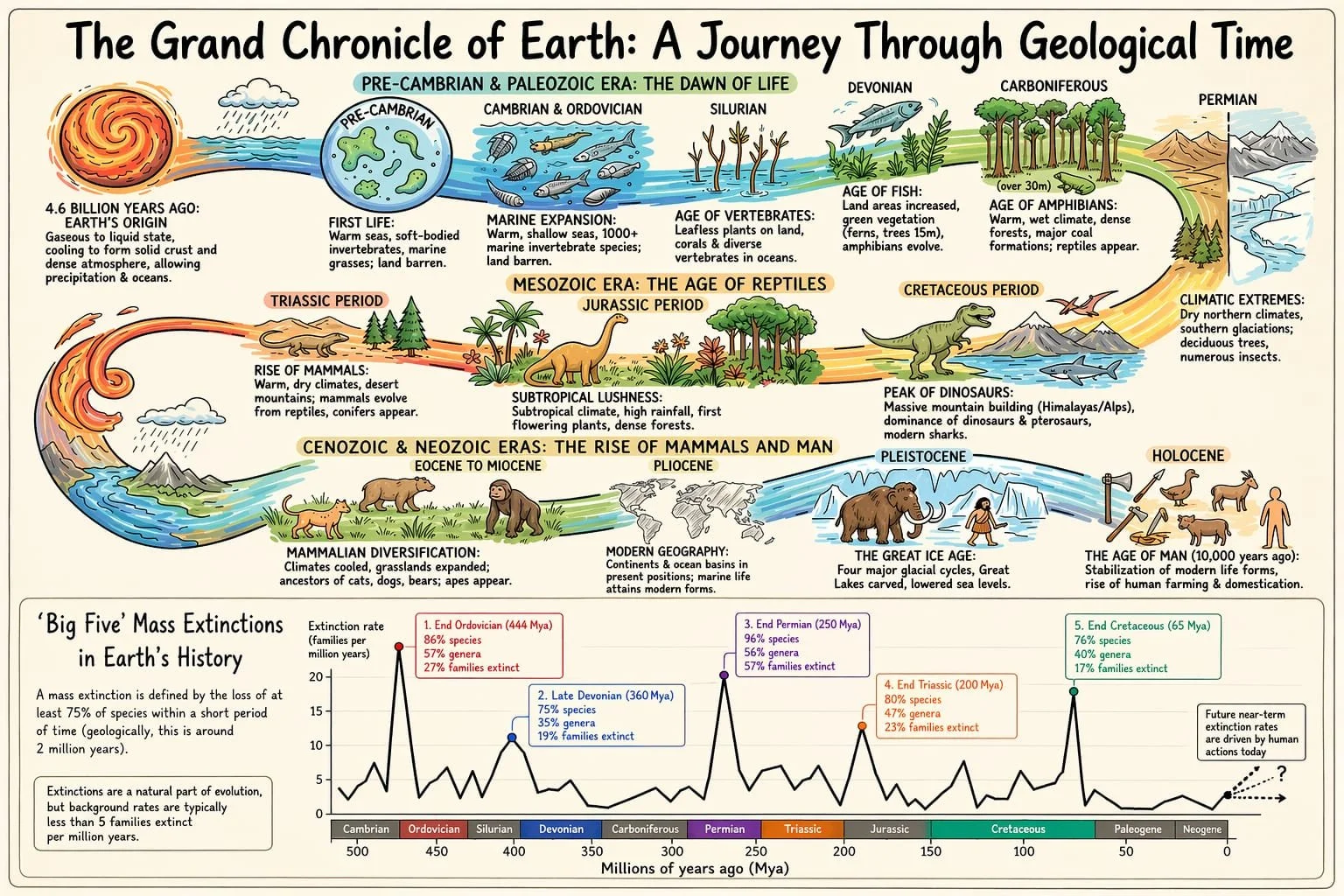
We know that our Earth is 4.5 billion years old and has had approximately 1 billion years to host complex life (multicellular organisms), and roughly 5 billion years before the sun engulfs it or leaves it as a scorched, airless rock. It started its journey as a ball of gas and water vapour and will end up as frozen dark rock. Within this period, it has already survived major mass extinction events, similar to what we are living through today. In the last 500 million years, life on Earth was nearly erased five times. Each time, the planet rebuilt from whatever survived, pushing through millions of years of recovery until the oceans filled again and the land turned green. Earth has a long record of outlasting catastrophe. The question worth asking is whether that record extends to what we are doing right now, and more precisely, how fast we are doing it.
To understand the speed, we must feel the scale.
The geological history of Earth spans 4.5 billion years. If you compress that entire lifespan into a single human century, 100 years standing in for 4.5 billion, modern Homo sapiens appear roughly two days and five hours before the present moment. Agriculture arrived about forty minutes ago. The entire Industrial Age, every coal seam burned, every factory built, every tonne of carbon dioxide pushed into the atmosphere, fits inside two minutes and twenty seconds. That is the actual ratio. And it changes the perspective about life on Earth. How fragile it is!
To comprehend the fragility of the current “miracle” of life, we must view Earth as a dynamic, living system that has evolved through 4.5 billion years of synergy. This vast timeline is the foundation of an equilibrium that allows us to exist, yet we treat it as a given rather than a strategic inheritance. Understanding our origins is the only way to grasp the magnitude of the disruption we have unleashed in such a short time. But first, we must acknowledge that we are a single, late-arriving link in a chain of innumerable factors that have shaped the biosphere. Our biosphere is a product of an infinite number of factors that are impossible to trace entirely. Yet, we can get the essence of these factors by studying the “Geological History of Earth”.
The Pre-Cambrian Super-Aeon / Archaean Era
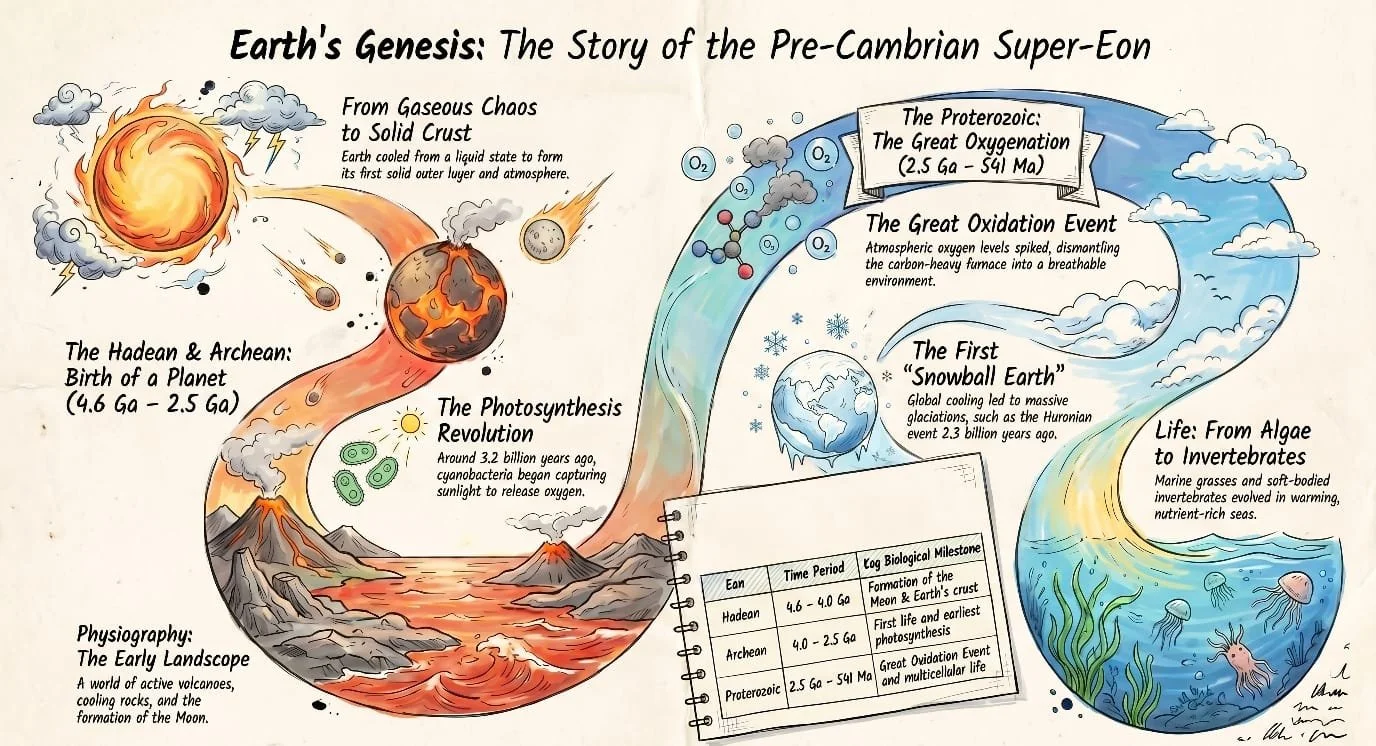
Earth did not begin as a place that could sustain life. The original atmosphere was dense with carbon dioxide and water vapour, a pressure cooker wrapped around a cooling rock. What made it habitable was a microorganism.
Around 2.7 billion years ago, during the Archaean Aeon, blue-green algae– cyanobacteria developed a metabolic trick to capture sunlight, split water molecules, and release oxygen as a byproduct. Over hundreds of millions of years, that single biological process dismantled the carbon-heavy atmosphere and replaced it with something breathable. We call it the Great Oxidation Event. It was, functionally, the first time life rewrote the planet's chemistry.
Even today, oceanic algae produce roughly 70% of Earth's oxygen. The planet's respiratory system was never its forests. It was always the oceans.
The rest of the Precambrian world, spanning over three billion years, was a slow construction. Water cycles in an eternal loop, shifting between liquid, vapour, and ice, meaning the molecules we consume today are the same ones that sustained every lineage before us. In a very literal sense, we are sharing a bath with the Tyrannosaurus rex. Soil forms in that fragile, living skin where raw mineral matter meets the ghost of decayed organic life. Coral reefs assemble themselves across vast spans of deep time. Wetlands serve as the planet's rhythmic sponge, absorbing the excess of wet seasons and releasing it during the dry. The entire biosphere evolved as a masterpiece of interdependence; nothing exists in isolation, and everything remains in a constant, delicate exchange with everything else.
Then life learned to diversify, and the extinctions began.
The Palaeozoic Era
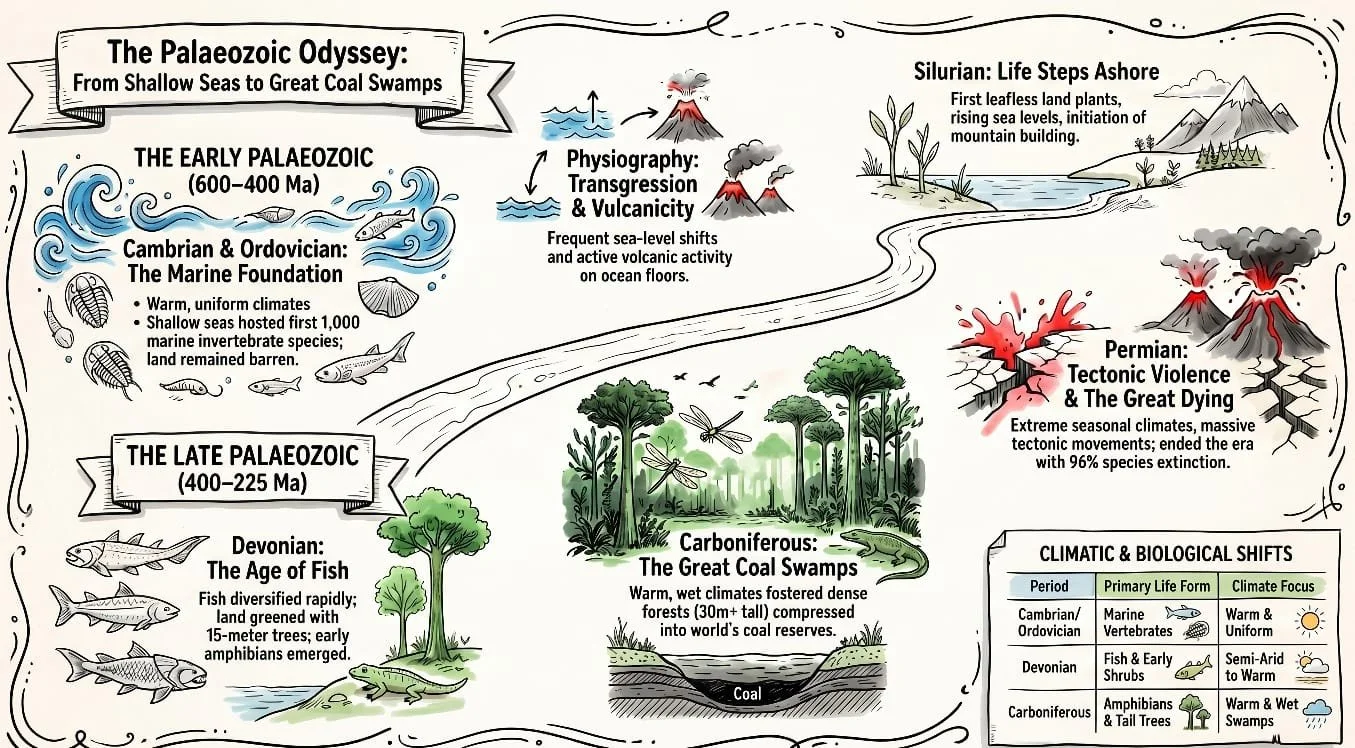
Around 541 million years ago, the Cambrian period dawned, introducing nearly a thousand species of marine invertebrates to the shallow, sun-warmed depths. While the continents remained desolate expanses of bare rock, the oceans had begun to hum with the first stirrings of complex existence.
The Ordovician followed, a time of rising mountains and volcanic eruptions across the sea floors, as vertebrates made their quiet debut. Life was finally gaining complexity and momentum. Then, 444 million years ago, the first of the Big Five catastrophes struck. A sudden, rapid glaciation caused sea levels to collapse, obliterating the shallow marine cradles where life had gathered.
In that freezing silence, 86% of all species were erased. The ocean, which had only just found its voice, was rendered nearly silent once more.
Life recovered. It always has. But it took millions of years.
Then, 440 million years ago, the Silurian brought plants ashore for the first time, leafless and simple, almost unrecognisable beside anything growing today. Then arrived the “Age of Fish”, the Devonian period, when the seas were still dominant, but the land was slowly turning green. Trees up to fifteen metres tall spread across the surface. Amphibians crawled out of the water. And then, 360 million years ago, the Late Devonian extinction erased 75% of species just as life was gaining serious momentum on land, resetting the clock on terrestrial life almost at the moment it had found its footing.
The Carboniferous period that followed reshaped the planet in ways we still extract value from today. Dense forests spread across the Northern Hemisphere. In places, the land sank slightly, drowning those forests in swamps. Over millions of years, those submerged forests compressed, transformed, and became coal. The coal that powered the Industrial Revolution was from a Carboniferous forest. That is not a metaphor. It is a direct material line between a 300-million-year-old ecosystem and the carbon we have been releasing into the atmosphere for the last two centuries.
Then, 250 million years ago came the Permian, the worst thing that ever happened to life on this planet. Massive volcanic eruptions across what is now Siberia pumped carbon dioxide and sulphur into the atmosphere over vast timescales, boiled the upper oceans, collapsed oxygen levels, and rained acid across the continents. Knocking down 96% of all species. The Great Dying. It took life ten million years to revive.
The Mesozoic Era
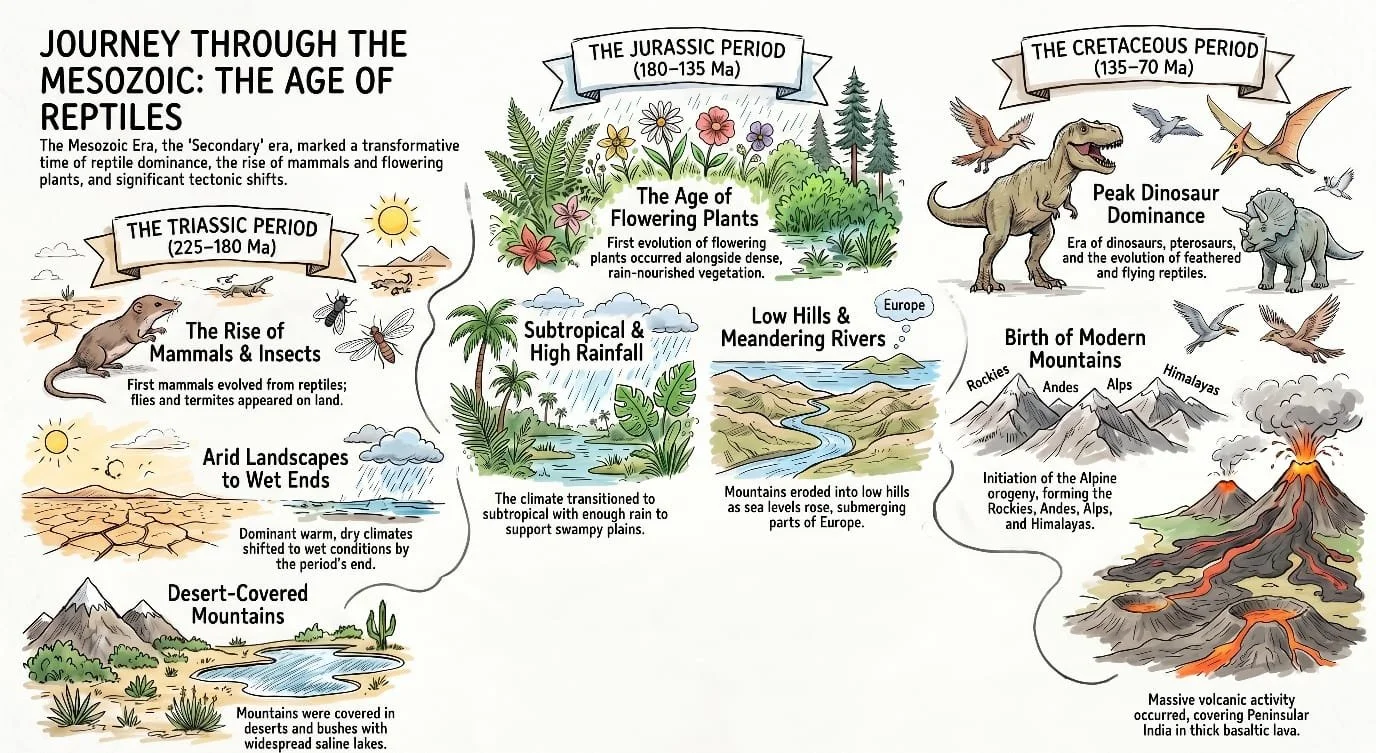
Beginning with the Triassic period, the Mesozoic Era saw the emergence of the first mammals, existing obscurely alongside dominant reptiles. The subsequent Jurassic period witnessed rising sea levels that once again inundated the continents, a time that also saw the evolutionary debut of flowering plants.
The transition between these periods, roughly 200 million years ago, was marked by a fourth mass extinction that eliminated 80% of existing species, effectively clearing the path for the eventual dominance of dinosaurs.
During the following Cretaceous period, massive tectonic shifts forged the great mountain ranges that still define our landscape, including the Alps, the Andes, the Rockies, and the Himalayas. While dinosaurs reached the height of their reign and the first feathered birds appeared, this era came to a violent conclusion 65 million years ago. A ten-kilometre-wide asteroid impact on the Yucatán Peninsula, in Mexico, triggered the fifth and most recent mass extinction, wiping out 76% of all species.
With the dinosaurs gone, the small, warm-blooded mammals that had survived in the shadows for 165 million years were finally granted the ecological space to flourish and diversify.
One of those mammal lineages, tens of millions of years later, produced us.
The Cenozoic Era
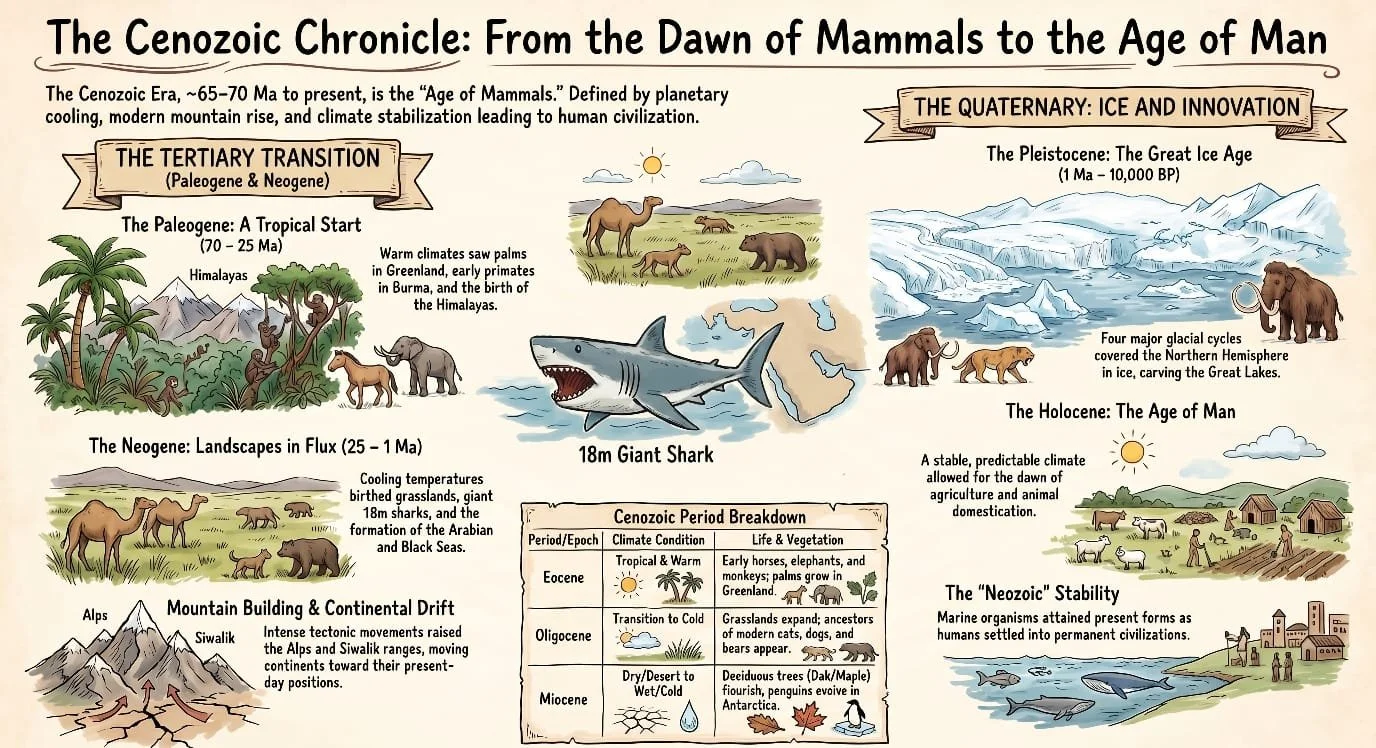
As the Cenozoic Era dawned around 65 million years ago, the planet settled into a long, slow cooling. During the Palaeocene, the "Age of Mammals, Insects, and Angiosperms" began, as warm-blooded lineages surged forward to fill every ecological niche the dinosaurs had vacated. Grasslands began to replace ancient forests, and the flowering plants we recognise today made their debut. The subsequent Eocene effectively erased the memory of reptiles from the oceans, giving rise to early whales and sea cows, while on land, the early ancestors of elephants, horses, and rhinos found their footing. During the Oligocene, intense tectonic movements forged the Alps, while the lineages of modern cats, dogs, and bears diverged; it was here, too, that our own story began with the evolution of the apes. The Miocene followed, a time when the Mediterranean became landlocked, the Himalayas experienced their second great upheaval, and penguins evolved in the frozen reaches of Antarctica. Finally, the Pliocene began 11 million years ago. It saw the continents drift into their final positions, and the third upheaval of the Himalayas, which sculpted the Siwalik ranges into the landscape I call home. And somewhere between 7 and 4 million years in this period, the early humans evolved “the Hominis”.
The Neozoic Era
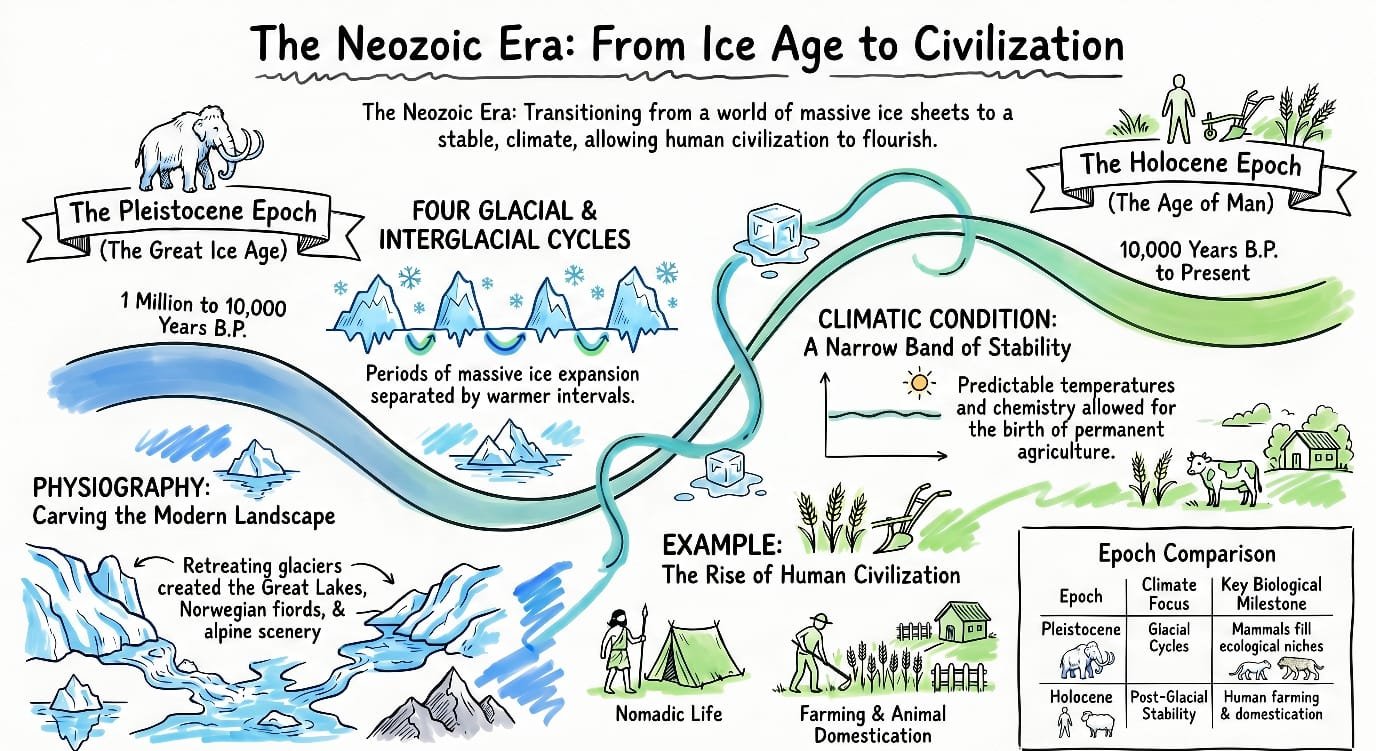
Nearly one million years ago, the Pleistocene brought the great glacial cycles, ice ages and interglacials alternating over hundreds of thousands of years, glaciers carving valleys, sea levels rising and falling, and entire species migrating or disappearing. And then, around 11,700 years ago, the ice retreated. The “Age of Man” Holocene began. The planet settled into the narrow, improbable band of temperature and atmospheric chemistry that allowed agriculture, permanent settlement, and everything we call civilisation to develop. Rivers found their courses. Forests returned. For the first time in a very long while, the climate became predictable enough to plant a crop and expect a harvest.
For approximately 180,000 years, Homo sapiens existed in harmony with this stability, living as nomads who followed seasonal patterns and gathered what the Earth provided. This long-standing balance was disrupted in phases, beginning 10,000 years ago with the advent of agriculture, which facilitated the first cities and surpluses. However, the most profound acceleration occurred with the utilisation of coal and oil—effectively "ancient sunlight" captured by plants over 100 million years and stored within their remains. Accessing this stored energy allowed humanity to transcend the limitations of muscle and current solar power, with one litre of oil providing the work equivalent of 100 people for an entire day.
This energy ratio fueled the rapid construction of the modern world. The transformation is visible in places like Shenzhen, which evolved from a fishing village in 1980 into a massive megalopolis in just forty years. Similarly, Shanghai erected 3,000 towers within two decades. These rapid developments are the direct result of a species consuming 300 million years of accumulated solar energy in less than two centuries.
The environmental impact extends far beyond carbon emissions. In western India, fossil water reserves that took 25,000 years to accumulate are depleting faster than the natural replenishment rate, leading to the abandonment of 30% of wells. The Amazon has lost 10% of its forests in four decades, and 75% of traditional crop varieties have been replaced by oil-reliant monocultures. Currently, climate injustice is at its peak; just 20% of the world's population utilizes 80% of the planet's mineral resources.
Earth's history includes five mass extinctions, each wiping out 75% to 96% of species due to geological or astronomical events such as volcanic activity or asteroid impacts. These events spanned millions of years, with recovery taking even longer. Unlike those authorless catastrophes, the current disruption is unique because human choices drive it. In a metaphorical "two minutes and twenty seconds" of Earth's history, we are dismantling an equilibrium that required 4.5 billion years to establish.
While the planet itself will likely survive and rebuild as it did after the "Great Dying," there is no assurance that the specific Holocene stability required for our civilisation will persist if we continue to push its boundaries. The Earth remains resilient, but our position within its system is precarious.
“For peace to reign on Earth, humans must evolve into new beings who have learned to see the whole first.” → Immanuel Kant
By Sahil Chauhan | Postgraduate in Geography | Climate Science Writer |
Reference
A Brief History of Earth → https://opengeology.org/historicalgeology/a-brief-history-of-earth/
Inside China’s ‘skyscraper capital’→ https://www.bbc.com/worklife/article/20170809-inside-chinas-skyscraper-capital
The spatialization of time and history in the skyscrapers of the twenty-first century in Shanghai→ https://link.springer.com/article/10.1186/s40410-021-00136-z#:~:text=Consequently%2C%20Shanghai%20has%20been%20among,%2DKodmany%202018:%2016).
Depletion in Groundwater Levels→ https://www.drishtiias.com/daily-updates/daily-news-analysis/depletion-in-groundwater-levels#:~:text=What%20is%20the%20Present%20Status,also%20fulfilled%20by%20ground%20water.
Amazon loses 10% of its vegetation in nearly four decades→ https://www.thehindu.com/sci-tech/energy-and-environment/amazon-loses-10-of-its-vegetation-in-nearly-four-decades/article66218285.ece#:~:text=In%20almost%20four%20decades%2C%2019,mainly%20to%20cattle%20ranching%20expansion.&text=Photo%20Credit:%20AP-,The%20Amazon%20region%20has%20lost%2010%25%20of%20its%20native%20vegetation,%2DEnvironmental%20Information%2C%20or%20Raisg.
Deforestation of the Amazon rainforest→ https://en.wikipedia.org/wiki/Deforestation_of_the_Amazon_rainforest
Natural Resources Deficit→ https://www.activesustainability.com/environment/natural-resources-deficit#:~:text=August%208%20was%20Earth%20Overshoot,or%20new%20trees%20and%20plants.
There have been five mass extinctions in Earth's history→ https://ourworldindata.org/mass-extinctions
